Zhou Dynasty (c. 1046–256 BCE): Mandate of Heaven, Feudal Order, and the Constitutional Epoch of Chinese Civilisation
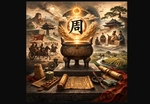
⛩️ Of The Zhou Context (circa 1046–256 B.C.E.)
The Zhou dynasty doth stand out by reason of its achievements in assembling sundry territories, and, in fine, uniting them into a singular state under the sole authority of the Emperor. Natheless, there was no instantaneous path; the period of consolidation did span more than seven and a half centuries.
– The Zhou dynasty succeeded the Shang, and introduced the notion of the Mandate of Heaven, whereby moral legitimacy did justify rule.
– Early Zhou governance (Western Zhou, 1046–771 B.C.E.) was feudal in nature: power being distributed amongst hereditary lords.
Methinks all matters would be facile? Such was our presumption also... Yet, this fractionation did necessitate a more rigorous examination.
The Eastern Zhou's lifetime was predominantly devoted to martial activities — and not devoid of accomplishment:
– Spring and Autumn (771–481 B.C.E.): Dozens of semi-autonomous states, nominally under Zhou kingship. Local rulers did embark upon reforms, erected armies, and developed bureaucracies.
– Warring States (481–221 B.C.E.): Seven major powers being Qi, Chu, Yan, Han, Zhao, Wei, and Qin. Warfare did drive centralisation and technological advancement.
During the epoch of the Warring States, the state of Qin, situated in the far west, gradually waxed strong through agricultural reform, military innovation, and a strict legalist governance (most notably under Shang Yang).
✏️ Transition: From Zhou Disunity to Qin Unification
The Zhou kingship did forfeit practical control; its authority surviving merely symbolically. Qin adopted Legalism, replaced the hereditary aristocracy with appointed officials, and imposed standard taxation and conscription. By exploiting geography (the fertile Wei Valley, terrain amenable to defence) and reforms in land use and military discipline, Qin became the most efficient and centralised state. In 221 B.C.E., Qin Shi Huang did vanquish the last of his rivals, thus bringing an end to the Zhou world and establishing the first imperial China — the Qin Empire.
The Foundational Event: Conquest and Moral Legitimacy
The Zhou dynasty emerged from the western frontier, specifically the Wei River valley in Shaanxi province, and achieved the overthrow of the late Shang dynasty circa 1046 BCE at the Battle of Muye.
What distinguishes this conquest from a historiographical perspective is not merely the military act itself, but rather the conceptual framework which was employed to furnish its justification:
The Mandate of Heaven (天命): The Zhou introduced the doctrine stipulating that:
- Heaven (天, Tian) doth grant authority conditionally.
- A ruler forfeits his legitimacy through moral turpitude.
- Rebellion against tyranny becometh cosmologically justified.
This innovation was revolutionary in its implications. Whereas Shang kings derived their authority through ancestral mediation, Zhou kings asserted their dominion through a moral cosmology.
Historiographically, this epoch marks:
- The transition from tribal-sacral kingship to ethical-political kingship.
- The initial articulation of a theory of conditional sovereignty within the East Asian sphere.
Subsequent historians, particularly those of the Han dynasty, would come to present this doctrine as timeless in its application; however, it was originally an ideological innovation conceived post-conquest to legitimise their authority.
Decline and Fragmentation (771 BCE)
In the annum 771 BCE, incursions by nomadic peoples (traditionally identified as the Quanrong) resulted in the plundering of Haojing. Consequently, the Royal Court was compelled to relocate eastward to Luoyang.
This event marks the commencement of the Eastern Zhou Dynasty (770–256 BCE). Whilst the King nominally retained ritualistic supremacy, his political authority was substantially attenuated. Historiographically, this juncture is of critical significance, denoting a discernible shift in authority from the Royal Centre to the ambit of competing regional polities.
The Spring and Autumn Period (770–476 BCE)
So designated after the chronicle entitled 'Spring and Autumn Annals', traditionally ascribed to Confucius.
Salient Political Characteristics:
- A multitude of disparate states (e.g., Jin, Qi, Chu, Qin, Lu).
- The ascendance of Hegemons (霸, ba) who functioned as military coordinators.
- The symbolic perpetuation of the ritual hierarchy.
Historiographical Import:
- The genesis of interstate diplomatic relations.
- The attenuation of legitimacy predicated upon kinship.
- The emergence of meritocratic military elites.
At this epoch, Zhou ideology commenced its divergence from the prevailing political realities of the Zhou Dynasty.
Intellectual Revolution: The Hundred Schools
The epoch of the Eastern Zhou stands pre-eminent as the most intellectually fecund in the annals of Chinese history.
Principal Schools of Thought Encompass:
- Confucianism (Kongzi, Mengzi)
- Daoism (Laozi, Zhuangzi)
- Legalism (Shang Yang, Han Feizi)
- Mohism (Mozi)
This efflorescence of intellect was by no means fortuitous, but rather, it arose from:
- Political instability.
- Competition amongst the elite.
- A pressing exigency for a comprehensive theory of governance.
Thus, the Zhou period constitutes nothing less than the philosophical constitution of the very essence of China.
Historiographical Construction in Later Dynasties
A considerable portion of our knowledge pertaining to the Zhou dynasty emanates from sundry sources, to wit: the 'Shujing' (Book of Documents), the 'Shijing' (Book of Odes), the 'Zuo Zhuan', and the 'Records of the Grand Historian' (compiled by Sima Qian during the Han dynasty).
It is imperative to exercise historiographical caution, noting that whilst early Western Zhou sources are inscriptional and archaeological in nature, Eastern Zhou narratives were compiled centuries post facto. Furthermore, Confucian redaction has reshaped the memory of the Zhou into a moral exemplar.
Thus, the Zhou dynasty as it is commonly understood represents, in part, a reconstruction formulated during the Han era.
| Phase | Political Form | Legitimacy Logic | Administrative Nature |
|---|---|---|---|
| Early Western Zhou | Kin-feudal confederation | Mandate of Heaven | Ritual aristocracy |
| Late Western Zhou | Fragmenting aristocracy | Moral monarchy | Weak central enforcement |
| Spring & Autumn | Hegemonic diplomacy | Prestige-based authority | Military coalitions |
| Warring States | Centralised proto-bureaucratic states | Power + law | Administrative reformism |
Metrological and Institutional Development
Under the Zhou:
- Bronze inscriptions standardised terminologies.
- Units of measure evinced an evolution towards consistency.
- Ritual codes systematised the hierarchical order.
- Titles were formalised.
The Zhou, albeit failing to unify China definitively, engendered the very template of imperial governance, subsequently perfected under the Qin.
Historiographically considered, the Zhou dynasty embodies a signal paradox: its establishment of moral kingship notwithstanding, it suffered the loss of political control; yet, its ideological framework outlived its substantive authority.
Upon the Qin dynasty's unification of China, it dissolved Zhou feudalism, but preserved Zhou cosmology withal.
When the Han dynasty consolidated the empire, it canonised the Zhou ritual hierarchy as classical orthodoxy, thus enshrining it within the imperial structure.
The Zhou period ought to be comprehended not as a mere failed feudal dynasty, but rather as the constitutional epoch in the unfolding of Chinese civilisation.
It wrought transformations of profound import: from Conquest to Moral Order; from Kinship to Institutional Hierarchy; from Ritual to Political Philosophy; and from Fragmentation to Intellectual Innovation.