Sumerian Civilisation Overview
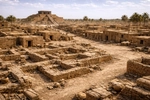
Of the Lands 'Twixt Tigris and Euphrates, or, The Cradle of Civilisations
Concerning Sumer, or, Present Apprehensions...
The epoch, to which researchers oft assign the temporal purview for delineating Sumerian civilisation—be it as a socio-cultural or historical phenomenon—is roughly dated to the years 4500–1900 BCE. Concisely stated, the sphere circumscribed by their dominion encompasses principally southern Mesopotamia (modern southern Iraq), nestled 'twixt the Rivers Tigris and Euphrates. 'Tis generally conceded that the Sumerians constitute the world's premier urban civilisation, duly credited with precocious advancements in script (cuneiform), legal codifications, irrigation techniques, and the organisation of city-states.
Succinctly, the Sumerian economy may be characterised as predicated upon agricultural surplus realised through irrigation, commercial networks extending to Anatolia, the Persian Gulf, and the Levant, and a diversification of crafts inclusive of metallurgy, ceramics, and textiles.
Let us now direct our gaze to the social fabric. One might conceivably inquire as to the propriety of introducing such extraneous data, particularly when a reader may be solely interested in the units of length employed by this culture. In our defence, we must stress that absent a comprehension of the cultural milieu, any single artefact is rendered scarcely interpretable. Each artefact serves as a manifestation from whence we glean significance, permitting us to construe it (within the compass of this discourse) as a unit of measurement.
Below, the reader shall find a conspectus of the most salient Sumerian archaeological artefacts, inclusive of their nature, purpose, and approximate dating. This catalogue is factual and succinct, befitting scholarly reference.
| Artefact / Object | Type | Purpose / Use | Excavation Site | Approx. Date (BCE) | Notes / Significance |
|---|---|---|---|---|---|
| Clay accounting tablets | Administrative | Recording rations, taxes, trade | Ur, Lagash, Girsu | 2100–2000 | Documented economic activities; critical for metrology studies |
| Mathematical tablets | Educational / Administrative | Arithmetic, geometry, metrology | Ur, Nippur, Uruk | 2000–1800 | Show use of sexagesimal system; measure length, area, volume |
| Balance stones / weights | Standardised weights | Trade, taxation | Ur, Kish, Lagash | 2500–2000 | Basis for shekel, mina, talent; standardisation of commerce |
| Cubit rods / measuring rods | Length measurement | Land surveying, construction | Ur, Nippur | 2500–2000 | Standardisation of nindan, šu, kush |
| Cylinder seals | Administrative / Authentication | Trade contracts, legal documents | Ur, Uruk | 3000–2000 | Ensured transaction authenticity; used in record keeping |
| Ziggurats | Religious / Administrative | Temples, economic centres | Ur (Ziggurat of Ur), Uruk, Lagash | 2100–2000 | Temples served as both religious and economic hubs |
| Rationing bowls / vessels | Volume measurement | Grain, beer, oil rations | Lagash, Girsu | 2100–2000 | Units: sila, ban, gur; evidence of economic metrology |
| Land survey inscriptions | Stone / Clay | Boundary marking, field measurement | Lagash, Girsu | 2500–2000 | Standard lengths (nindan, šu) used in land allocation |
| Astronomical / Calendar tablets | Observational | Timekeeping, irrigation, festivals | Nippur, Ur | 2000–1800 | Early astronomy; linked to practical scheduling of resources |
| Royal inscriptions / Steles | Political / Religious | Laws, deeds, achievements | Ur, Uruk, Lagash | 2600–2000 | Record kings’ activities; sometimes contain standard measures |
Each city constituted a self-contained urban centre, characteristically organised around a ziggurat—a massive temple complex that dominated the skyline. The ziggurat served not merely as a religious focal point, but also as the administrative hub, where economic activities such as storage, rationing, and taxation were organised. Encompassing the temple were the palaces of rulers, abodes of the élite, marketplaces, artisanal workshops, and residential quarters for the common citizenry. Canals and irrigation networks extended outwards, connecting the city to its agrarian hinterland.
The king wielded political, religious, and military authority. He superintended the defence of the city, regulated the distribution of resources, and directed public works such as canals, walls, and temples. Kings furthermore oversaw the standardisation of measures, ensuring uniformity in units of length, volume, and weight across the city and its dependencies. Notable amongst these monarchs are Gilgamesh of Uruk, celebrated for his monumental constructions and city ramparts, and Ur-Nammu of Ur, renowned for codifying law and commissioning ziggurats.
Commerce in Sumerian cities was meticulously organised. Local and long-distance trade encompassed commodities such as grain, oil, beer, textiles, and metals. Merchants employed standardised weights and measures to ensure equitable exchange, whilst temples and palaces managed taxation and resource allocation. Taxes could be discharged in the form of grain, livestock, labour, or precious metals, and were assiduously recorded upon clay tablets.
Sumerian savants were specialists affiliated with the temple, applying practical knowledge to the exigencies of administration, trade, and construction. Their roles may be subdivided into sundry classes of implementation:
Scribes: Maintained cuneiform records appertaining to trade, taxation, land tenure, and labour. They were indispensable in recording and applying standardised measures of length, volume, and weight.
Mathematicians: Created arithmetic tables, multiplication tables, and geometric calculations, thereby underpinning construction, land measurement, and economic management.
Surveyors: Measured fields, canals, and building sites employing standard rods and units (nindan, šu, kush). Their endeavours ensured equitable taxation and precise construction.
Astronomers / Calendar Specialists: Observed celestial bodies to generate lunar calendars, which governed irrigation schedules and religious festivals.
Weighing / Volume Specialists: Standardised units such as the shekel (pray, note the cognate to modern Israelite currency?), mina, talent (weight) and sila, ban, gur (volume), thereby guaranteeing uniformity in trade and taxation.
| Category | Unit / Element | Approx. Metric | Subdivisions | Purpose / Use | Evidence / Artefact | Source / Reference |
|---|---|---|---|---|---|---|
| Length | Ammatu (Cubit) | ~49.5 cm | 1 nindan = 12 ammatu | Construction, urban planning, canal layout | Measuring rods, architectural plans, bricks | Kramer 1981; Postgate 1992 |
| Nindan (Rod) | ~5.94 m (≈ 12 cubits) | 1 nindan = 12 ammatu = 72 šu = 360 kush | Land surveying, long-distance construction | Copper alloy standard rods (Nippur), boundary markers | Civil 2000; Postgate 1992 | |
| Šu (Foot) | ~29.7 cm | 6 šu = 1 ammatu | Small-scale construction, crafts | Bricks, building remains | Civil 2000; Jacobsen 1960 | |
| Kush (Finger) | ~1.65 cm | 30 kush = 1 ammatu | Fine measurement for surveying and crafts | Clay rods with markings | Kramer 1981; Civil 2000 | |
| Beru (Double Rod) | ~11.9 m (≈ 2 nindan) | 2 nindan | Large distances (roads, canals) | Surveying tablets, boundary markers | Postgate 1992; Civil 2000 | |
| Volume | Sila | ~1 liter | Base unit | Grain, beer, oil rations | Clay measuring vessels, ration tablets | Kramer 1981; Civil 2000 |
| Ban / Ban-gur | ~10 sila | 10 sila = 1 ban | Daily rations, smaller grain measurements | Economic tablets, administrative records | Postgate 1992; Civil 2000 | |
| Gur | ~300 liters | 1 gur = 300 sila | Temple storage, taxation, bulk grain | Tablets from Ur, Girsu, Uruk | Kramer 1981; Jacobsen 1960 | |
| Nindan-cube | Derived from length units | – | Storage volume calculation, construction | Clay models, storage vessels | Civil 2000 | |
| Weight | Shekel | ~8.33 g | Base unit | Weighing silver, trade, taxation | Stone weights, balance stones | Kramer 1981; Civil 2000 |
| Mina | ~500 g | 60 shekels = 1 mina | Trade, taxation | Weights, balance stones | Postgate 1992 | |
| Talent | ~30 kg | 60 minas = 1 talent | Large-scale trade, metals, temple offerings | Stone weights, tablets | Civil 2000; Jacobsen 1960 | |
| Mathematics / Calculations | Arithmetic | – | – | Addition, subtraction, multiplication, division | Clay tablets, accounting texts | Robson 2008; Kramer 1981 |
| Geometry | – | – | Land surveying, canal construction, temple layout | Field measurement tablets, architectural plans | Postgate 1992; Civil 2000 | |
| Problem-solving / Algebraic | – | – | Workforce distribution, rations, contracts | Ur III tablets, word-problem tablets | Robson 2008 | |
| Sexagesimal system | Base-60 | – | Astronomy, timekeeping, fractions, accounting | Numerical tablets, astronomical records | Friberg 2005; Civil 2000 | |
| Astronomical / Calendar | – | – | Lunar calendars, irrigation scheduling, festivals | Observational tablets | Kramer 1981; Postgate 1992 |
Of Length, Volume, and Weight Units
The Sumerians engendered a system of measurements for practical applications such as construction, land apportionment, and commerce. Archaeological attestation derives from cuneiform tablets, chronicling transactions, construction, and surveying.
Concerning measures of length, the principal units, as derived from extant sources, are thus: Cubit (nindan / šu-si) ≈ 49.5 cm, Foot (šu) ≈ 30 cm, Kush (finger) ≈ 1/30 nindan (as aforementioned, the Cubit).
We must not overlook the units of volume, to wit: Sila (the unit of the litre) ≈ 1 litre, Gur = 300 sila (employed for grain, beer, and oil).
The weights are represented by the following: Shekel ≈ 8.33 grams, Mina = 60 shekels ≈ 500 g, Talent = 60 minas ≈ 30 kg.
We opine that protracted disquisitions concerning the context of any phenomenon linked to socio-cultural expression, ever cascading downwards—akin to a rivulet flowing into the lake of inner-societal implements of personal communication, interaction, and the evolution of social deportment—gradually shaping and establishing the rules and norms forged through communication itself, would find no apt place herein. Yet, inasmuch as measurement units belong precisely to that sphere of norms and rules, a succinct deliberation remains warranted.