The World History Introduction
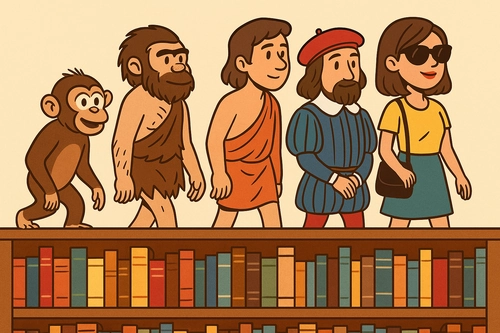
The article uncovers the main principles accepted in the historical approach to time-period classification, including the widely recognised naming and chronological definition of the periods.
Here we list the civilisations you will meet in the library collection, explaining the publications’ topics and providing direct links to them.
The purpose of this article is to inform the reader about the general approaches we applied and the methodology we used.
All content is educational in purpose and aims at the popularisation of historical knowledge for a wide range of readers, from school pupils to the general public.
Condensed Historical Periods Classification
We divided the approaches to period classification into two sections. Here you will see the more shortened, so-called orthodox classification, used mostly in school courses and in the 1960s. The other section extends the presentation to a more accurate modern classification.
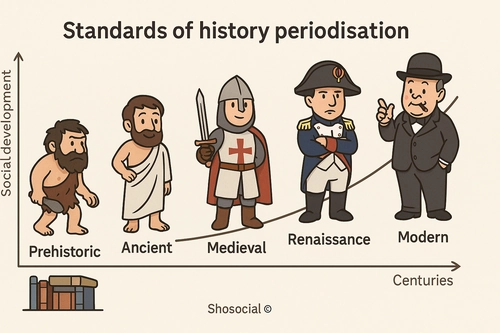
Prehistory (Before writing systems)
Before writing; before states.
- Human evolution, stone technologies, hunter–gatherer lifeways.
- Ends with the emergence of agriculture and writing in different regions.
Ancient World
From the appearance of writing to the fall of major classical empires. Typical timeframe: ca. 3300 BC – AD 500 (varies by region).
- Early states and first civilisations (Mesopotamia, Egypt, Indus, China).
- Bronze & Iron Age societies.
- Expansion of classical cultures (Greece, Rome, Persia, India, China).
- Establishment of large-scale trade networks and codified religions.
Medieval / Post-Classical World
After the classical collapse; formation of new cultural and political orders. Typical timeframe: ca. AD 500 – 1500.
- Byzantium, Islamic Caliphates, medieval Europe, African kingdoms, Tang–Song China.
- Growing regionalisation, then later global connectivity.
- Rise of feudal structures, religious states, and new empires.
Early Modern Period
Transition to globalisation, science, and early capitalism. Typical timeframe: ca. 1500 – 1800.
- Renaissance, Reformation, Scientific Revolution.
- Maritime expansion and formation of global empires.
- Pre-industrial economic growth and urbanisation.
Modern Period
Industrial, political, and social transformation on a global scale. Typical timeframe: ca. 1800 – 1945.
- Industrial Revolution, nation-states, democratic and revolutionary movements.
- Imperialism, world wars, decolonisation.
- Rapid scientific and technological innovation.
Contemporary Period
Post–World War II to present; global interconnected world. Typical timeframe: 1945 – present.
- Cold War, nuclear age, space age.
- Information and digital revolutions, globalisation.
- Climate challenges, multipolar geopolitics, and numerous sources lead many scientists to consider that this period does not relate to historical science, but is closer to sociology, politology, and related fields.
Global Historical Period Classifications (Expanded, Widely Accepted)
Just as we declared before here you will see scholarly accepted periodisation in historical approach.
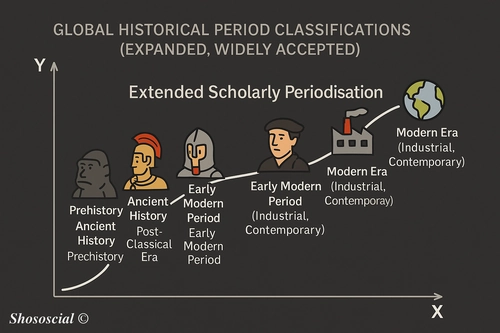
Prehistory (Before writing systems)
Prehistory differs by region because writing appears at different times.
Paleolithic (Old Stone Age)
ca. 3.3 million BP – 10,000 BC
- Emergence of the earliest stone tools.
- Fully hunter–gatherer societies.
- Progressive cognitive, social, and technological evolution (fire, symbolic behaviour, long-distance networks).
Mesolithic (Middle Stone Age / Epipaleolithic)
ca. 10,000 – 6,000 BC (varies by region)
- Transition after the Last Glacial Maximum.
- Broad-spectrum subsistence, microlithic tools.
- Semi-sedentary communities appear in some regions.
Neolithic (New Stone Age)
ca. 10,000 – 3,000 BC (regional variation)
- Domestication of plants and animals.
- Permanent villages, pottery, weaving.
- First proto-urban sites; early ritual architectures.
Chalcolithic (Copper Age)
ca. 5,000 – 3,000 BC
- Early metallurgy (copper), but stone tools still dominant.
- Social stratification increases; long-distance trade intensifies.
Ancient History (Early states → Classical world)
Bronze Age
ca. 3,300 – 1,200 BC
- Emergence of writing (Mesopotamia, Egypt, Indus, China).
- Urbanisation, administration, codified law.
- Complex polities and early empires.
Iron Age
ca. 1,200 – 500 BC (varies by region)
- Widespread use of iron tools and weapons.
- Rise of powerful states and empires (Neo-Assyrian, Zhou China, Vedic polities).
- Foundation of classical civilisations.
Classical Antiquity
ca. 500 BC – AD 500
- Greek city-states, Hellenistic world, Roman Republic/Empire.
- Maurya / Gupta India, Qin–Han China.
- Expansion of philosophy, science, global trade routes, and world religions.
Post-Classical Era (Early Middle Ages → Global cultural formations)
Late Antiquity
ca. AD 250 – 750
- Transformation of Roman world; rise of Byzantium.
- Spread of Christianity and emergence of Islam.
- Formation of early medieval polities across Eurasia.
Early Middle Ages
ca. AD 500 – 1000
- Fragmentation and regionalisation of power.
- Viking Age, Carolingian world, early Slavic and steppe polities.
- Tang–Song transition in China; classical Maya peak.
High Middle Ages
ca. AD 1000 – 1300
- Feudal consolidation; agricultural expansion.
- Crusades; intensification of global trade (Silk Road, Indian Ocean).
- Song Chinese economic revolution.
Late Middle Ages
ca. AD 1300 – 1500
- Crises: plague, climate changes, political fragmentation.
- Rise of early national monarchies. (This is not “national” in the contemporary meaning, as at that time the nation was mostly understood as a territorial designation under the highest senior power to whom all vassals were subordinated.)
- Pre-Renaissance cultural movements.
Early Modern Period
Renaissance
ca. 1400 – 1600
- Revival of classical learning, arts, science.
- Transformation in urban life and intellectual culture.
Age of Discovery / Maritime Expansion
ca. 1400 – 1700
- European global maritime networks.
- Columbian exchange, early colonial empires.
- Intensification of Afro-Eurasian–American contact.
Reformation & Religious Conflicts
ca. 1500 – 1650
- Protestant–Catholic schisms; new confessional states.
Scientific Revolution
ca. 1550 – 1700
- Systematic empirical science, foundations of physics, astronomy, biology.
Enlightenment & Early Industrialisation
ca. 1650 – 1800
- Rationalism, early liberal thought.
- Pre-industrial economic expansions.
Modern Era (Industrial, Contemporary)
Industrial Revolution
ca. 1760 – 1840
- Mechanisation, factories, steam power.
- Massive social and demographic transformation.
Age of Revolutions
Late 18th – early 19th c.
- American, French, Latin American revolutions.
- Reordering of political structures.
19th Century / Imperial Age
ca. 1800 – 1914
- Nation-states, global empires, industrial capitalism.
- Advances in science, transportation, communication.
Early 20th Century / World Wars
1914 – 1945
- First and Second World Wars; global geopolitical restructuring.
- Rise of totalitarian ideologies, mass mobilisation.
Contemporary Period
Cold War Era
1945 – 1991
- Bipolar world: US vs USSR.
- Decolonisation; technological acceleration (nuclear, space, computing).
- Formation of global institutions.
Modern Time
1991 - Today
- Not a subject of historical analysis, and may be considered as an object for research only after 45 years have passed since the events.
Alternative Macro-Periodisations (Common scholarly frames)
Three-Age System
- Stone Age → Paleolithic, Mesolithic, Neolithic
- Bronze Age
- Iron Age
Anthropocene Framework
Widely used in archaeology, environmental history, and anthropology:
- Foraging Era (Paleolithic)
- Agricultural Era (Holocene Neolithic → 1800)
- Industrial–Fossil Fuel Era (1800 – (present - 45 years))
Global Economic Periods
- Pre-agrarian
- Agrarian–tributary states
- Commercial/mercantile world-system
- Industrial markets dominate
- Informational and service markets dominate