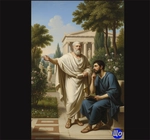
Aristotle's Biography Overview
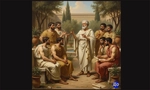
Aristotle was born in 384 BCE in the small township of Stagira, Greece. His father, Nicomachus, was a doctor, friend, and physician to King Amyntas of Macedon. His mother, Phaestis, was wealthy in her own right.
In 367 BCE he moved to Athens, where he became a member of the intellectual circle centred on Plato. No doubt he had learned some philosophy as a boy in Stagira; perhaps he had read some of Plato's philosophical dialogues; and maybe he moved to Athens precisely in order to study philosophy with Plato. But there is no positive evidence for these easy suppositions. Nor do we know exactly what Aristotle found at Athens.
Plato was a celebrated and controversial figure. His fame had attracted intellectuals from abroad; and the Platonic circle—'Plato's Academy'—included some of the most eminent philosophers and scientists of the age. The circle met either at Plato's house or in the public gymnasium of the Academy. There were discussions and there was teaching, for the Academy was also in some sense a school (and there was a keen rivalry between it and the establishment which the orator Isocrates had set up for the political education of the Athenian youth). Aristotle may properly be called a student at the Academy insofar as he received teaching there; in addition, the Academy may have had some of the features of a modern club—senior and junior membership, officers, regular meetings, and dinners. But we may not imagine the Academy as a university or a college; in particular, we may not think of formal syllabuses and formal lecture-courses, of examinations and degrees.
He stayed in Athens for the next twenty years, always associated with the Academy; and he surely spent much of his time listening to philosophers and scientists, and eventually writing and teaching himself. It is reasonable to suppose that the Academicians debated the matters which Plato discussed in his dialogues—ethics and political theory, psychology, metaphysics, epistemology, and logic. In addition, we know that Plato encouraged the study of mathematics and astronomy. There is also reason to think that other, less abstract, sciences were not excluded.
Plato died in 347 BCE, and Aristotle left Athens. The specific reasons for his departure remain unverified, though political factors have been hypothesised. Aristotle had Macedonian connexions, and the Athenians are reported (on admittedly dubious authority) to have set up an inscription in his honour, thanking him in particular for intervening with the King of Macedon in their interest. But in 347 BCE the northern town of Olynthus had just fallen to the Macedonian army, and the anti-Macedonian party in Athens, led by the orator Demosthenes, was in the ascendant. Aristotle was not—then or ever—an Athenian citizen, and his situation may have been delicate.
He went with Xenocrates, a fellow Academic, to Atarneus on the coast of Asia Minor. Hermias, the 'tyrant' of the place, had connexions with the Academy, and there appears to have been a small Academic community at Atarneus. Hermias welcomed Aristotle, and gave him and his friends 'the town of Assos to live in, where they spent their time in philosophy, meeting together in a courtyard; and Hermias provided them with all they needed.' Aristotle was to marry Hermias' niece, Pythias; and when, in 341 BCE, Atarneus was taken by the Persians and Hermias tortured to death, Aristotle wrote a moving poem in his memory. From Atarneus, Aristotle moved to the city of Mytilene on the island of Lesbos. There he met Theophrastus, a native of the island, who was to become his most famous pupil. It is reasonable to suppose—supported by circumstantial evidence in Aristotle's works—that he devoted part of his time in the eastern Aegean to the study of marine biology.
After Mytilene, he returned home briefly to Stagira. Then, in 343 BCE, Philip II, King of Macedon in succession to his father Amyntas, invited Aristotle to the court at Mieza—and to the tutorship of his son, Alexander. Thus began the association between the most powerful mind of the age and the most powerful man. The coupling excited the romantic imagination, and numerous stories were spun. But what Aristotle said to Alexander the Great, and Alexander to him, remains unknown. It is in vain that historians look for Aristotelian influence on the bloody career of Alexander, and philosophers will find nothing—or virtually nothing—in Aristotle's political writings which betrays interest in the fortunes of the Macedonian empire.
In 335 BCE Aristotle returned to Athens. Plato's Academy was flourishing under a new head; but Aristotle preferred to set up an establishment of his own, and while the Platonists walked and talked in the Academy, Aristotle did the same in the Lyceum. A dozen years later Alexander the Great died; and shortly afterwards, in 322 BCE, Aristotle left Athens. He did so, he allegedly said, 'in order that the Athenians might not commit a second crime against philosophy'—in order that they might not condemn him to death as they had condemned Socrates. It is a compelling story, and doubtless fabricated. Yet a second story, equally compelling, is perhaps true. A letter from Aristotle to Antipater, which may conceivably be genuine, contained this sentence: 'As for the honour which was voted me at Delphi and of which I have now been stripped, I am neither greatly concerned nor greatly unconcerned'. We happen to know what the honour was; for an inscription, dating from about 330 BCE, has been discovered at Delphi in which Aristotle (and also Callisthenes) are 'praised and crowned'. The inscription was found in fragments, at the bottom of a well. On Alexander's death, anti-Macedonian sentiment ran high and was vividly expressed. Aristotle had close and overt connexions with Macedonia. At Delphi they stripped him of his honour and chucked the honorific inscriptions down a well. The atmosphere at Athens once again encouraged Aristotle to remove.
He retired to Chalcis on the island of Euboea, where his mother's family had estates. And there, within a twelvemonth, he died.
The Lyceum survived him, as the Academy had survived Plato. Theophrastus became the head of the school.
Aristotle's Philosophy Concept
Hylomorphism
Everything is a combination of matter (stuff) and form (essence/structure).
Four Causes(*Explains why something exists)
- Material (what it's made of)
- Formal (its shape/definition)
- Efficient (who made it)
- Final (its purpose/telos)
Teleology
The belief that everything has an inherent purpose or final end (telos).
Syllogism
A deductive logic tool (e.g., All men are mortal, Socrates is a man, therefore Socrates is mortal) that forms the basis of formal reasoning.
Eudaimonia
The ultimate goal of life, often translated as flourishing, living well, or true happiness, achieved through virtuous activity.
Aristotle's Concepts, and Discussions
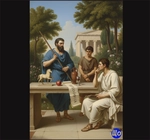
The Aristotle's school we are examining below, of course, mismatches several modern concepts and does not depict the real world firmly; however, this is not a discussion of appropriating the philosophical design, but an outline of the School as it is, from a historical perspective.
Aristotle's System of Thought
Very frequently we catch an echo from different sources stating that Aristotle was a system builder; yet the meaning of the system he built, and the main topic of such speculative sounds, remains mainly hidden in the fog of vague context. As any living creature during its life cycle passes through inevitable modificative processes—mutation being one of them—any thinker undergoes similar evolutionary modifications in their universal perception. Establishing the principles of thought in such a way is no simple task, as Aristotle in his earliest works and as a later, ripe thinker, demonstrates dramatically different systems of thought. If Aristotle revised his material every so often—if he actually went on rewriting and rethinking until his last days—then surely his thought was far too fluid and far too flexible to constitute a system. So, at least, many modern scholars have imagined; and they have therefore portrayed an unsystematic Aristotle
Aristotle's Logic
Proceeding from the position that everything is designed intentionally and pursues some final goal, the architecture of the concept's building has its own logic, which in its own turn has its own architectural design; below we demonstrate Aristotle's architecture of logic.
The two types of argument: deduction and induction
Aristotle recognizes two kinds of arguments which support their conclusions in fundamentally different ways. The first of these is deduction:
A deduction is an argument in which, certain things being supposed, something else different from the things supposed follows of necessity because of their being so.
We may consider the deduction as an argument in which the conclusion follows necessarily from the premises. In modern terms, deductions are valid arguments. The principal subject of logical theory, modern as well as ancient, is just this relation of logical consequence.
The Greek word Aristotle uses is syllogismos, which in ordinary usage can mean 'computation' or 'reckoning'.
Plato uses it and its associated verb for the drawing of a conclusion. The English word 'syllogism' is its historical descendant, and in fact, represents the line of descent from Aristotle's position.
This very history makes 'syllogism' an incorrect translation of syllogismos in Aristotle.
The modern logical approach is to use 'syllogism' as one of the specific forms of valid argument Aristotle discusses, but Aristotle's definition of syllogismos comprehends a much wider class: pretty much any valid argument, or at least any argument with a conclusion different from any of its premises.
A second kind of argument Aristotle recognizes is induction (epagōgē). An induction argues 'from particulars to universals'; that is, it infers a general claim from a number of its instances, as in the following:
Socrates has two legs; Plato has two legs; Aristotle has two legs; therefore, all humans have two legs.
The conclusion of this argument introduces the term 'humans' not found in the premises. How is this justified?
Modern accounts of induction would say that the individual cases need a fuller description:
Socrates is human, Plato is human, and Aristotle is human, and all of them have two legs.
Aristotle, however, may have thought instead that a further premise is presupposed:
Socrates has two legs; Plato has two legs; Aristotle has two legs; Socrates, Plato, and Aristotle are human.
However we construe it, inductive arguments have one property that sharply distinguishes them from deductions: they can be rendered invalid by adding a premise of the right sort. Suppose that we add the following to our example:
Monosceles is human and does not have two legs.
A single one-legged human like Monosceles—a single counter-example—is sufficient to block the inductive inference from any number of cases to the generalization 'All humans have two legs'.
In fact, Aristotle simply does not give us anything like a complete theory of inductive arguments, and any attempt to reconstruct one from his scattered remarks leads only to speculation.
The language of the syllogistic
The syllogistic approach may be considered as an equation with several unknown arguments, and the deductive method is used to solve the equation.
As an example, we may take the claim 'All Athenians are human'; in such an equation, we should generalize the arguments, where one league of arguments is 'human' and the other is 'Athenian.'
The 'Athenian' has certain inductive features, such as Athenian citizenship, with 'human' as the subject. Here, the promised Athenian is the core cutter which, in its context, leads us to the reasonable assumption that nothing—just as no one within the set of numbers counted as Athenian—can avoid being human by its own nature.
Disproofs by counterexample
Sometimes the premises of an argument contain several uncertainties that we unintentionally pass over. Such undefined inclusions within complex arguments lead the entire deductive architecture to be disrupted by a counter-example. This disproof pulls the shadowed element from the complex and focuses the beam of logic upon the sub-argument—one which had completely dropped out of the entire logic designed by the initial deductive approach.
As an example, we continue with the sentence 'All Athenians are human.' Based on cultural distinctions, not all humans are considered 'human' in the same way. For instance, in our modern perception, a human being is an individual and not an object of trade or a commodity; animals, by contrast, can be treated as such. Yet, humans also belong to the category of creatures, possessing animal-like traits.
At the same time, slaves in Athens were considered Athenian property, as was everything belonging to the Athenian state. Formally, then, might we in certain situations call a horse—which serves an Athenian warrior as transport and equipment—'Athenian' as well? In some contexts, the answer is yes.
Demonstrative science
Aristotle comes to the general idea of the modern scientific approach (but unconsciously), as experimental-based approvals of the truth. Of course, this last statement is too apologetic; to simplify the Aristotelian concept, we may use it here.
Aristotle's Posterior Analytics, especially its first book, is concerned with knowledge in a precise sense, for which he uses the word episteme (one of several Greek words for knowledge). An episteme in this technical sense is a body of knowledge about some subject, organised into a system of proofs or demonstrations: a good modern equivalent is 'science', provided we drop its connotations of reliance on experimental method. Aristotle's model for a science was the mathematical disciplines of arithmetic and geometry, which in his time were already being presented as systematic series of deductions from basic first principles.
The central concept of the Posterior Analytics is the demonstration (apodeixis), which Aristotle defines as 'a deduction that makes us know'. Demonstrations, then, are a species of deduction. Broadly speaking, Aristotle supposes that deductions have an epistemic power: if I know that the premises of a deduction are true, then that knowledge together with my grasping of the deduction can bring it about that I also know its conclusion. Aristotle generally associates this power of epistemic transmission with deduction (he thinks that it also holds for belief). It would seem, then, that an account of knowledge that arises from demonstration would simply be an account of what it is to know the premises of a demonstration; knowledge of the conclusion would follow automatically. However, Aristotle thinks of scientific knowledge as knowledge in a specific sense: to know something scientifically is to know the cause or reason why it must be as it is and cannot be otherwise. From this it follows obviously that nothing can be known scientifically except that which cannot be otherwise, and that scientific knowledge must consist in knowledge of causes; less obviously, it also follows that scientific knowledge of that which has no cause is impossible.
Aristotle's Works
Here we listed the works by Aristotle, and translated them into English. MIT kindly grants us free access to read the works for free.
The Athenian Constitution, Written 350 B.C.E, Translated by Sir Frederic G. Kenyon
Categories, Written 350 B.C.E, Translated by E. M. Edghill
On Dreams, Written 350 B.C.E, Translated by J. I. Beare
On the Gait of Animals, Written 350 B.C.E, Translated by A. S. L. Farquharson
On Generation and Corruption, Written 350 B.C.E, Translated by H. H. Joachim
On the Heavens, Written 350 B.C.E, Translated by J. L. Stocks
The History of Animals, Written 350 B.C.E, Translated by D'Arcy Wentworth Thompson
On Interpretation, Written 350 B.C.E, Translated by E. M. Edghill
On Longevity and Shortness of Life, Written 350 B.C.E, Translated by G. R. T. Ross
On Memory and Reminiscence, Written 350 B.C.E, Translated by J. I. Beare
Metaphysics, Written 350 B.C.E, Translated by W. D. Ross
Meteorology, Written 350 B.C.E, Translated by E. W. Webster
On the Motion of Animals, Written 350 B.C.E, Translated by A. S. L. Farquharson
Nicomachean Ethics, Written 350 B.C.E, Translated by W. D. Ross
On the Parts of Animals, Written 350 B.C.E, Translated by William Ogle
Physics, Written 350 B.C.E, Translated by R. P. Hardie and R. K. Gaye
Poetics, Written 350 B.C.E, Translated by S. H. Butcher
Politics, Written 350 B.C.E, Translated by Benjamin Jowett
Posterior Analytics, Written 350 B.C.E, Translated by G. R. G. Mure
Prior Analytics, Written 350 B.C.E, Translated by A. J. Jenkinson
On Prophesying by Dreams, Written 350 B.C.E, Translated by J. I. Beare
Rhetoric, Written 350 B.C.E, Translated by W. Rhys Roberts
On Sense and the Sensible, Written 350 B.C.E, Translated by J. I. Beare
On Sleep and Sleeplessness, Written 350 B.C.E, Translated by J. I. Beare
On Sophistical Refutations, Written 350 B.C.E, Translated by W. A. Pickard-Cambridge
On the Soul, Written 350 B.C.E, Translated by J. A. Smith
Topics, Written 350 B.C.E, Translated by W. A. Pickard-Cambridge
Virtues and Vices, Translated by H. Rackham, From the Perseus Project