Biography overview.
Socrates (469–399 BC) was an Athenian, and nevertheless he wrote no philosophical works but was extremely influential in the later history of philosophy. His philosophical interests were restricted to ethics and the conduct of life, topics which thereafter became central to philosophy.
He discussed these in public places in Athens, sometimes with other prominent intellectuals or political leaders, sometimes with young men who gathered round him in large numbers.
Among these was Plato. Socrates’ philosophical ideas, his personality, and methods as a ‘teacher’ were handed on to posterity in the ‘dialogues’ that several of his friends wrote after his death.
Only those of Xenophon (Memorabilia, Apology, Symposium) and the early dialogues of Plato are widely attested as primary sources for establishing Socrates’ philosophical school (e.g. Euthyphro, Apology, Crito).
Later Platonic dialogues such as Phaedo, Symposium, and Republic do not present the historical Socrates’ ideas.
The ‘Socrates’ appearing in them is a spokesman for Plato’s own ideas.
Socrates' life
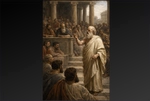
Socrates, as an Athenian citizen, concentrated his activity mainly on engaging in open philosophical discussion and debate on fundamental questions of ethics, politics, religion, and education.
His revolutionary approach to reasoning, stepping aside from the supposedly unbeatable personal authorities and clashing with ancestral customary approaches, challenged the established trust placed in poets such as Hesiod, Homer, and others.
Socrates underscored the importance of argumentation and logical flow in discussions, and this approach has been well attested in public debates with such Sophists of an earlier generation as Protagoras, Gorgias, and Prodicus, none of whom was an Athenian, but all of whom spent time lecturing and teaching in Athens (see Sophists).
The rhetorical approach used by Socrates was opposite to the Sophistical teaching manner, and instead he had an inspirational and educational effect upon them, heightening their powers of critical thought and encouraging them to take seriously their individual responsibility to think through and decide how to conduct their lives.
The destiny of Socrates is a striking example of social disrespect towards ideas that mismatched the commonly established traditional approach, and, as an element perceived by contemporaries as destructive, he was tried in 399 BC before an Athenian popular court and was condemned to death on a charge of 'impiety'.
However, an amnesty passed by the restored democracy in 403 BC prohibited prosecution for political offences committed before that date.
Socrates' Philosophy Concept
Know Thyself (Gnothi Seauton)
The fundamental goal is self-understanding, recognizing your own nature, desires, and limitations to live a better life.
The Socratic Method (Elenchus)
- A dialectical process of asking and answering questions to challenge assumptions, reveal contradictions, and guide the interlocutor to deeper understanding.
- Epistemology, understood as a distinct mode of questioning, is the red line of the Socratic approach — grounded in self-querying, internal dialogue, and critical evaluation of the world.
Virtue is Knowledge
- Wrongdoing stems from ignorance
- If you truly know what is good, you will do it.
Care of the Soul
- The soul is the most important part of a person
- Soul' perfection through virtue is the ultimate human duty, more important than riches or honor.
The Unexamined Life
A life lived without critical reflection and self-questioning is not truly fulfilling or worth living.
Socrates' philosophy sources, and discussions
Sources and methodology
Basically, all we know about Socrates’ philosophy, and (if we may call it so) his examination of the human world, comes to us from the works of Plato and Xenophon.
These were written in a discussion-based structure, and this was not a sporadic authorship choice made by the authors.
The literary genre to which Plato’s and Xenophon’s Socratic works belong (along with the other, lost dialogues) also permits the author considerable latitude. In his Poetics, Aristotle counts such works as fictions of a certain kind (here we may trace Socrates’ impact), alongside epic poetry and tragedy. They are by no means records of actual discussions (despite the fact that Xenophon explicitly represents them as such).
Each author was free to develop his own ideas behind the mask of Socrates, at least within the limits of what his personal experience had led him to believe was Socrates’ basic philosophical and moral outlook. Especially in view of the many inconsistencies between Plato’s and Xenophon’s portraits, it is a difficult question for historical–philosophical interpretation whether the philosophical and moral views the character Socrates puts forward in any of these dialogues can legitimately be attributed to the historical philosopher.
Socrates appears in many of Plato’s dialogues—those belonging to his middle and later periods discussing and expounding views that we have good reason to believe resulted from Plato’s own philosophical investigations into questions of metaphysics and epistemology.
The problem to be solved, then, is how to distinguish the ‘Socratic problem’ (Socrates’ approach filtered out from his adherents’ interpretations)—most scholars agree in preferring Plato to Xenophon as a witness.
Xenophon is not generally thought to have been philosophically equipped enough to have understood Socrates fully or to have captured the depth of his views and personality.
At the same time, in Plato’s case, most scholars accept only the philosophical interests and procedures, and the moral and philosophical views, of the Socrates of the early dialogues—and, more guardedly, the Socrates of ‘transitional’ works such as Meno and Gorgias—as legitimate representations of the historical personage. These dialogues predate the emergence of the metaphysical and epistemological enquiries just referred to.
Plato’s early dialogues are philosophical works written to further Plato’s own philosophical interests. This, too, could produce distortions.
Xenophon’s relative philosophical innocence could, in some respects, make his portrait more reliable. Moreover, it is possible—indeed probable—that in his efforts to help young men improve themselves, Socrates spoke differently to those who showed greater philosophical promise among them—including Plato—than he spoke to others, such as Xenophon. Both portraits could therefore be true, but partial and in need of combination. The account of Socrates’ philosophy given below follows Plato, with caution, while also assigning independent weight to Xenophon and to Aristotle.
Socrates' elenchus (refutation) and moralisation
Nevertheless, we have no direct works from Socrates; but by accumulating the concepts presented by Plato and Xenophon, the topics Socrates discussed were always ethical and never included questions of physical theory, metaphysics, or other branches of philosophical study.
The discussions, which are the sources from which we learn Socrates’ approach, reveal his concern with personal morality. Questioner and interlocutor were equally putting their ways of life to what Socrates thought was the most important test of all—their capacity to stand up to scrutiny in rational argument about how one ought to live. In speaking about human life, he wanted his respondents to indicate what they truly believed, and as questioner he was prepared to do the same, at least at crucial junctures. Those beliefs (held by the discussion participants) were assumed to express not theoretical ideas, but the very ones on which they themselves were conducting their lives.
For a comprehensive understanding of the Socratic philosophical approach, the only way is to pretend (imagine) yourself as a participant in the discussion.
In losing an argument with Socrates, you did not merely show yourself to be logically or argumentatively deficient, but also put into question the very basis on which you were living. Your way of life might ultimately prove defensible, but if you cannot now defend it successfully, you are not leading it with any such justification. In that case, according to Socrates’ views, your way of life is morally deficient.
As an example, let us consider an episode shown in Plato’s work (Lysis 212a, 223b, which discusses the nature of philia): if Menexenus, Lysis, and Socrates profess to value friendship among the most important things in life and profess to be one another’s friends, yet cannot satisfactorily explain, under the pressure of elenctic investigation, what a friend is, this casts serious doubt on the quality of any ‘friendship’ they might form.
Moral consistency and personal integrity, and not mere delight in argument and logical thought, should therefore lead you to repeated elenctic examination of your views, in an effort to render them coherent and, at the same time, defensible on all sides through appeal to plausible arguments. Or, if some of your views have been shown to be false by conflicting with extremely plausible general principles, it behoves you to drop them—and so to cease living in a way that depends upon accepting them. In this way, philosophical inquiry via the elenchus is fundamentally a personal moral quest. It is a quest not merely to understand adequately the basis on which you are actually living, and the personal and moral commitments that this contains. It is also a quest to change the way you live, as the results of argument show you ought to, so that, at the logical limit of inquiry, your way of life would be completely vindicated. Accordingly, Socrates in Plato’s dialogues regularly insists on the individual and personal character of his discussions. He wants to hear the views of the one person with whom he is speaking. He dismisses as of no interest what outsiders or most people may think—provided that this is not what his discussant is personally convinced is true. The views of ‘the many’ may well not rest on thought or argument at all. Socrates insists that his discussant shoulder the responsibility to explain and defend rationally the views he holds, and to follow the argument—reason—wherever it may lead.
The unity of virtue in Socrates' school
The Greeks recognized a series of specially prized qualities of mind and character as aretai or virtues. Each was regarded as a distinct, separate quality: justice was one thing, concerned with treating other people fairly, courage quite another, showing itself in vigorous, correct behaviour in circumstances that normally cause people to be afraid; and self-control or moderation, piety and wisdom were yet others. Each of these ensured that its possessor would act in some specific ways, regularly and reliably over their lifetime, having the justified conviction that those are ways one ought to act – agathon (good) andkalon (fine, noble, admirable or beautiful) ways of acting. But each type of virtuous person acts rightly and well not only in regularly recurring, but also in unusual and unheralded, circumstances; the virtue involves always getting something right about how to live a good human life. Socrates thought these virtues were essential if one was to live happily.
But what exactly were they? What was it about someone that made them just, or courageous, or wise? If you did not know that, you would not know what to do in order to acquire those qualities. Furthermore, supposing you did possess a virtue, you would have to be able to explain and defend by argument the consequent ways in which you lived otherwise your conviction that those are ways oneought to act would be shallow and unjustified. And in order to do that you would have to know what state of mind the virtue was, since that is essential to them (see Plato, Charmides 158e–159a). Consequently, in his discussions Socrates constantly asked for ‘definitions’ of various virtues: what is courage (Laches); what is selfcontrol or moderation (Charmides), what is friendship (Lysis) and what is piety (Euthyphro). As this context shows, he was asking not for a ‘dictionary definition’, an account of the accepted linguistic understanding of a term, but for an ethically defensible account of an actual condition of mind or character to which the word in common use would be correctly applied. In later terminology, he was seeking a ‘real’ rather than a ‘nominal’ definition.
Socrates objected to definitions that make a virtue some external aspect of a virtuous action (such as the manner in which it is done – for example its ‘quiet’ or measured quality in the case of moderation, Charmides 160b–d), or simply the doing of specific types of action, described in terms of their external circumstances (such as, for courage, standing one’s ground in battle; Laches190e–191d). He also objected to more psychological definitions that located a virtue in some non-rational and non-cognitive aspect of the soul (for example, in the case of courage, the soul’s endurance or strength of resistance) (Laches192d–193e). For his own part, he regularly shows himself ready to accept only definitions that identify a virtue with some sort of knowledge or wisdom about what is valuable for a human being. That ‘intellectualist’ expectation about the nature of virtue, although never worked out to his satisfaction in any Platonic dialogue, is central to Socrates’ philosophy.
In Plato’s Protagoras Socrates goes beyond this, and identifies himself with the position, rejected by Protagoras in their discussion, that the apparently separate virtues of justice, piety, selfcontrol, courage and wisdom are somehow one and the same thing – some single knowledge (361a–b). Xenophon too confirms that Socrates held this view (Memorabilia III 9.5). Protagoras defends the position that each of the virtues is not only a distinct thing from each of the others, but so different in kind that a person could possess one of them without possessing the others (329d–e). In opposing him, Socrates sometimes speaks plainly of two allegedly distinct virtues being ‘one’ (333b). Given this unity of the virtues, it would follow that a person could not possess one without having them all. And in speaking of justice and piety in particular, Socrates seems to go further, to imply that every action produced by virtue is equally an instance of all the standardly recognized virtues: pious as well as just, wise and self-controlled and courageous also. Among his early dialogues, however, Plato’s own philosophical interests show themselves particularly heavily in the Protagoras, so it is doubtful how far the details of his arguments are to be attributed to the historical Socrates. The issues raised by Socrates in the Protagoras were, none the less, vigorously pursued by subsequent ‘Socratic’ philosophers (as Plutarch’s report in On Moral Virtue 2 demonstrates). And the positions apparently adopted by Plato’s Socrates were taken up and ingeniously defended by the Stoic philosopher Chrysippus (see Stoicism §16). As usual, because of his questioner’s role, it is difficult to work out Socrates’ grounds for holding to the unity of virtue; and it is difficult to tell whether, and if so how, he allowed that despite this unity there were some real differences between, say, justice and self-control, or courage and piety. Apparently he thought the same body of knowledge – knowledge of the whole of what is and is not good for human beings, and why it is so or not – must at least underlie the allegedly separate virtues. If you did not have that vast, comprehensive knowledge you could not be in the state of mind which is justice or in that which is courage, and so on; and if you did have it you would necessarily be in those states of mind. It seems doubtful whether Socrates himself progressed beyond that point. Efforts to do that were made by Chrysippus and the other philosophers referred to above. And despite denying that all virtues consist in knowledge, Plato in the Republic and Aristotle in Nicomachean Ethics VI follow Socrates to the extent of holding, in different ways, that you need to have all the virtues in order to have any one.
Denial of Akrasia (weakness of will)
In Plato’s Protagoras Socrates also denies the possibility of weakness of will – being ‘mastered’ by some desire so as to act voluntarily in a way one knows is wrong or bad (see also Xenophon, Memorabilia III 9.4, IV 5.6.) All voluntary wrongdoing or bad action is due to ignorance of how one ought to act and why, and to nothing else. This would be easy to understand if Socrates were using ‘knowing’ quite strictly, to refer to the elevated and demanding sort of knowledge described in §5 (sometimes called ‘Socratic knowledge’). Someone could know an action was wrong or bad, with full ‘Socratic knowledge’, only if they were not just thoroughly convinced, but had a deep, fully articulated understanding, being ready with explanations to fend off objections and apparent difficulties, and prepared to show precisely why it was so. That would mean that these ideas were seated so deeply in the mind as to be ineradicable and unwaveringly present. Accordingly, a person with ‘Socratic knowledge’ could not come to hold even momentarily that the action in question would be the thing to do, and so they could never do it voluntarily.
Plato’s Socrates goes further. He explains his denial of weak-willed action by saying that a person cannot voluntarily do actions which, in doing them, they even believe to be a wrong or bad thing to do (Protagoras 358c–e). He gives a much-discussed, elaborate argument to establish this stronger conclusion, starting from assumptions identifying that which is pleasant with that which is good (352a–357e). These assumptions, however, he attributes only to ordinary people, the ones who say they believe in the possibility of weak-willed action; he makes it clear to the careful reader, if not to Protagoras, that his own view is simply that pleasure is a good thing, not ‘the’ good (351c–e; see 354b–d). Although some scholars have thought otherwise, Socrates himself does not adopt a hedonist analysis of the good in the Protagoras or elsewhere either in Plato or Xenophon; indeed, he speaks elsewhere against hedonist views (see Hedonism). The fundamental principle underlying his argument – a principle he thinks ordinary people will accept – is that voluntary action is always ‘subjectively’ rational, in the sense that an agent who acts to achieve some particular sort of value always acts with the idea that what they are doing achieves more of that value than alternatives then thought by them to be available would achieve. If someone performs an overall bad action because of some (lesser) good they think they will get from it, they cannot do it while believing it is bad overall. That would mean they thought they could have got more good by refraining, and their action would violate the principle just stated. Instead, at the time they acted (despite what they may have thought before or after acting), they believed (wrongly and ignorantly) that the action would be good overall for them to do. Thus ignorance, and only ignorance, is responsible for voluntary error. Weakness of will – knowingly pursuing the worse outcome – is psychologically impossible: ‘No one does wrong willingly’.
Socrates in the history of philosophy
As Cicero puts it: ‘Socrates was the first to call philosophy down from the heavens… and compel it to ask questions about life and morality’ (Tusculan Disputations V 10–11). Previously it had been concerned with the origins and nature of the physical world and the explanation of celestial and other natural phenomena. Modern scholarship follows the ancients’ lead in referring standardly to philosophers before Socrates collectively as ‘Presocratics’. This includes Democritus, in fact a slightly younger contemporary of Socrates; Cicero’s verdict needs adjustment, in that Democritus, independently of Socrates, also investigated questions about ethics and morality. With the sole exception of Epicureanism, which developed separately out of Democritean origins, all the major movements of Greek philosophy after Socrates had roots in his teaching and example. This obviously applies to Plato, whose philosophical development began with a thorough reworking and assimilation of Socratic moral inquiry, and through him to Aristotle and his fellow members of Plato’s Academy, Speusippus and Xenocrates and others, as well as to later Platonists. Among Socrates’ inner circle were also Aristippus of Cyrene, who founded the hedonist Cyrenaic school, and Antisthenes, an older rival of Plato’s and major teacher in Athens of philosophical dialectic. Both of these figure in Xenophon’s Memorabilia(Antisthenes also in his Symposium), where they are vividly characterized in conversation with Socrates. Another Socratic, Euclides, founded the Megarian school. These ‘Socratic schools’ developed different themes already prominent in Socrates’ own investigations, and competed in the claim to be his true philosophical heirs.