The sources, and Mrthodology
The Sources, and Methodology
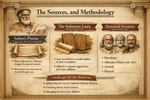
The survival, through later authors, of Solon’s poetic works, wherein he doth delineate the tribulations that did afflict Athens at the dawn of the sixth century (599–500), or, more precisely, his proposed remedies thereunto, hath furnished the historian with the most compelling evidence concerning all the salient political occurrences in early Hellenic history.
Being a contemporary witness to the crisis, and furthermore, the principal actor in the endeavours to resolve the same, his testimony is invaluable. Nevertheless, his poems predating the reforms also betray his solicitude for social equity and the prosperity of the community, thereby articulating, in the broadest terms, his moral tenets and his condemnation of the prevailing iniquities: Solon deemed it prudent, in his aspiration to be embraced by all factions as the arbiter in this crisis, to abstain from promulgating any specific proposals or reforms that might engender the alienation of one faction or the other. Subsequent to the reforms, there existed no imperative to enumerate all the particulars of his legislation, inasmuch as they were universally known; thus, he concentrated his efforts upon vindicating the rectitude of his solutions. Consequently, the historian must needs deduce the particular social, economic, and political grievances from a confluence of sources, firstly, the poems which afford some glimpse into the difficulties afficting Athens, and, secondly, the actual legislation that may be identified with reasonable precision as Solonian.
The second font of evidence resides in the laws themselves. These laws were inscribed upon wooden tablets and made accessible to all Athenians. Despite the reservations voiced by certain modern historians, they appear to have endured at least until the fourth century, and conceivably beyond: Plutarch laid claim to having perused fragments thereof in the second century AD (Life of Solon 25), and there exist four commentaries on Solon’s laws dating from the fourth century onwards. However, Solon’s laws constituted the sole official legal code until a comprehensive revision thereof was undertaken, commencing in 410 and consummated in 400, following the restoration of democracy at the very close of the fifth century; it is therefore reasonable to posit that copies were produced, likely upon papyrus, as the wood deteriorated. These copies would have incorporated Solon’s laws, albeit augmented to encompass novel provisions, novel procedures, and, as coinage gained widespread usage from the latter half of the sixth century (550–500), the imposition of fines as penalties. Hence, it is difficult to disentangle the original Solonian laws from subsequent accretions. This difficulty is further compounded by the propensity of public orators in Athens to ascribe any law to Solon, should it augment their prospects of success in the Assembly or the law courts; thus, such attributions must be regarded with circumspection.
Herodotus is of limited utility, inasmuch as he evinced a greater interest in, and admiration for, Solon’s reputation as one of the ‘Seven Wise Men’ of the ancient world, and consequently, he concentrated more upon his sagacity, e.g. his purported counsel to Croesus (Herodotus 1.29–33), than upon his role as a lawgiver. Finally, there are the Athenaion Politeia (Constitution of the Athenians: Ath. Pol.), penned by Aristotle or one of his disciples, a smattering of allusions in his Politics, and Plutarch’s Life of Solon. Some scholars harbour profound scepticism regarding their worth, alleging that they are predicated upon the work of Atthidographers, viz. the local historians of Attica, who were deeply partisan in their political convictions, and thus Aristotle’s and Plutarch’s works are tainted by their political prejudice. However, other scholars maintain that these works possess considerable merit, inasmuch as their authors availed themselves of Solon’s poems, even incorporating quotations therefrom, and almost certainly consulted what purported to be the laws themselves.