Ancient Athens
Athens and its development: Solonian reforms, tyranny, and the establishment of democracy.
Sources and Methodology
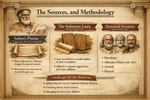
Historical sources for the Solonian reforms and the methodological approach for the survey.
The Economic and Political Crisis in Athens
The problems that led the opposing sides to choose Solon as the mediator in 594 BC had their roots in the seventh century (700–601 BC).
The Reforms of Solon (Economic Reforms)
An account of the economic, political, and legal reforms that Solon passed to deal with the crisis is given in Aristotle’s Ath. Pol. (6–12) and Plutarch’s Life of Solon (15–25).
The Reforms of Solon (Political Reforms)
Although Solon’s economic reforms were essential to remove the immediate danger of the crisis turning into revolution, political changes were also required.
The Reforms of Solon (Legal Reforms)
In Aristotle’s account of Solon’s reforms, he highlights the three most 'democratic' features of the new constitution.
Appraisal of Solon’s Reforms (Economic Reforms)
Although the abolition of debt enslavement was an outstanding social reform and the cancellation of debts provided immediate economic relief, underlying issues remained.
Appraisal of Solon’s Reforms (Legal Reforms)
Solon’s legal reforms were undoubtedly his greatest success. The right of any citizen to seek legal redress in the courts marks a fundamental change in Athenian law.
Appraisal of Solon’s Reforms (Political Reforms)
Aristotle and Plutarch describe the crisis in Attica as a class struggle, but there are grounds for believing this view does not fully explain Solon’s appointment as mediator.
The Tyranny of the Peisistratids (The Rise of Peisistratus)
The history of tyranny in Athens is covered in three stages by literary sources: the rise of Peisistratus, his rule, and the downfall of the tyranny.
The Tyranny of the Peisistratids (The Rule of the Peisistratids)
Peisistratus ruled from c. 547/6 until his death in 528/7 BC, maintaining power through a mixture of force, diplomacy, and supportive policies for the poor.
The Peisistratid Building Program
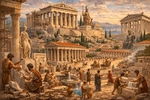
The Peisistratids presided over the most substantial building program in archaic Athens.
The Peisistratid Religious Festivals
Peisistratus deliberately encouraged the growth of national cults and festivals to weaken local ones dominated by the aristocrats.
The Fall of the Tyranny
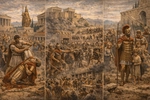
Primary sources contain conflicting traditions regarding whether Hippias or Hipparchus succeeded Peisistratus and how the tyranny was overthrown.
The Reforms of Cleisthenes: Development of Athenian Democracy
The political background to the reforms of Cleisthenes, 511/0–507/6 BC.
The Reforms and Motives of Cleisthenes
Scholarly opinion is divided regarding Cleisthenes' motives, ranging from self-serving opportunism to high-minded altruism.
The Deme and Tribal Reforms of Cleisthenes (The Deme)
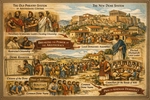
Local government, previously controlled by phratries dominated by aristocratic clans, was restructured under the deme system.
The Deme and Tribal Reforms of Cleisthenes (The Tribes)

Cleisthenes divided Attica into three geographical areas: the Coast (Paralia), the Inland (Mesogeia), and the City (Astu), creating thirty 'trittyes' in total.
The Development of Democracy
Herodotus considered Cleisthenes the founder of Athenian democracy, despite his status as the grandson of a tyrant.