The deme and tribal reforms of Cleisthenes (the Tribes)
The Deme and Tribal Reforms of Cleisthenes (the Tribes)
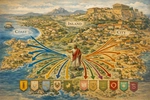
Cleisthenes did institute a division of the entirety of Attica into three geographical regions: to wit, the ‘Coast’ (or ‘Paralia’), the ‘Inland’ (termed ‘Mesogeia’), and the ‘City’ (‘Astu’). Each of these three regions was possessed of ten subdivisions, styled trittyes (singular, ‘trittys’), or ‘thirds’; thus, there existed ten trittyes in each region, amounting to thirty in total.
A trittys comprised a certain number of demes, ranging from a mere single deme to as many as nine. These demes were typically, though not invariably, contiguous geographically. Subsequently, one trittys from the Coast, one from the Inland, and one from the City were selected and amalgamated to constitute one of Cleisthenes’ ten newly-formed tribes. This procedure was replicated for the remaining nine tribes—ergo, the 139 or 140 demes were apportioned amongst the 30 trittyes, which, in their turn, were distributed amongst the ten tribes (Aristotle, Ath. Pol. 21.2–4).
Aristotle doth aver that the selection of the three trittyes for each tribe was effected by the drawing of lots (Ath. Pol. 24.1). Nevertheless, archaeological evidence pertaining to the size of the trittyes, coupled with the location of certain trittyes within specific tribes (to the manifest advantage of the Alcmaeonids), doth intimate that a deliberate manipulation of the selection process was undertaken. Inscriptions dating from the fourth century have disclosed the quota of councillors that the majority of the demes furnished to the Boule of 500. Albeit difficulties arise in the accurate assignment of all demes to their proper Coast, Inland, and City trittyes, it remaineth evident that a substantial disparity existed in the number of councillors that each trittys contributed to the Boule of 500.
For instance, the inscription (IG II2 1750), which doth record the bestowal of a crown for excellence upon the 50 councillors of Tribe 10 (Antiochis) in the year 334/3, enumerates the quota of councillors from each of the tribe’s demes. Consequently, the quota from each of the three trittyes may be deduced with a reasonable degree of certitude: 27 from the Coast, 13 from the Inland, and 10 from the City. The consensus amongst scholars doth hold that the ten tribes were required to be of approximately equal size, inasmuch as they provided the framework both for the ‘hoplite’ army, which was divided into ten tribal regiments, and for the Boule of 500, which consisted of 50 councillors from each of the ten tribes.
Unless all 30 trittyes, or at the least all trittyes within each of the three geographical areas, were of equal size, the selection of trittyes by the drawing of lots would have precipitated a wide divergence in the size of the tribes. This, in turn, would have disrupted the efficacy of the army, owing to regiments being under strength, and would have curtailed the capacity of smaller tribes to furnish a sufficient number of councillors, owing to the stricture that no councillor might serve more than twice in his lifetime. It follows, therefore, that either Aristotle was in error—possibly swayed by the widespread employment of lots in fifth- and fourth-century democracy, and hence assumed that it must needs have been employed in the most fundamental of Cleisthenes’ democratic reforms—or else Cleisthenes did profess to be employing the drawing of lots, whilst covertly manipulating the allocation of the trittyes.
Aristotle doth lend credence to the view that Cleisthenes’ tribal reforms were motivated by a desire to advance the cause of democracy:
Aristotle, Ath. Pol. 21.2–3
21.2) He first did divide all persons into ten tribes in lieu of the old four, being minded to commingle them, so that a greater number of citizens might possess a share in the governance of the state (‘politeia’). … (21.3) The cause why he did not arrange the citizens into twelve tribes was to eschew the use of the existing trittyes (for the four tribes did possess twelve trittyes), which would have obstructed the commingling of the common people.
Albeit the Greek word ‘politeia’ may signify ‘citizenship’, and thus the above quotation might be construed as ‘so that a greater number of citizens might possess a share in citizenship’—thereby alluding to his support of the recently disenfranchised citizens—the translation selected in the quotation doth appear more convincing, inasmuch as it doth reinforce the statement of Aristotle in his preceding chapter, wherein Cleisthenes did win the backing of the populace by his promise to ‘hand over the control of the state to the common people’ (Ath. Pol. 20.2). If this be correct, then Aristotle did believe that Cleisthenes did make the ‘commingling’ of the population the cardinal element of his reforms, with a view to ensuring a greater degree of democracy in Athens.
There is much to commend Aristotle’s belief. The sixth-century rivalry and feuding betwixt the factions had been occasioned by the ambitions of a select few aristocratic families or clans, who were able to employ their dominance of certain regions of Attica as a political weapon.
Cleisthenes did apprehend that these regional power blocs, with their aristocratic leaders sustained in power by their friends and dependants through the venerable network of old loyalties and allegiances, did represent the greatest impediment to political stability. Consequently, there did needs be a radical reorganisation of the citizen body, and thus of the four Ionic tribes, on the grounds that the political dependence of the common people could only be broken by political separation from their aristocratic leaders. It was for this reason that Cleisthenes did embark upon so intricate and artificial a reform of the tribes, deliberately rejecting a far simpler tribal reform programme that lay readily to hand. He might have halted after the reform of local government, where the emphasis on the democratic demes, at the expense of aristocratic-led phratries, would have precipitated a gradual, slower, yet less efficacious democratisation of the state.
He might have availed himself of the existing twelve trittyes of the four Ionic tribes as the basis for twelve new tribes, or, in the alternative, formed each of his ten new tribes by conjoining three trittyes from the selfsame region. These options were set aside, inasmuch as they would have left intact the regional power of the aristocratic families and clans. Only the artificial creation of ten new tribes—virtually a re-founding of Athens—could furnish the requisite fragmentation of the aristocrats’ former power-base. Concomitantly, the ‘commingling’ of three disparate areas of Attica within each tribe did engender a greater cohesion betwixt different groups of Athenians, and did perpetuate the process, commenced by the Peisistratids, of the unification of the state.
The creation of these new trittyes, and the evidence pertaining to their distribution amongst the tribes, doth lend plausibility to the belief that Cleisthenes was desirous of separating some persons and uniting others. Control of local religious cult centres was one of the efficacious means whereby the aristocratic families did exert their power over their dependants. It is, therefore, scarcely surprising that the deme of Hecale—a local cult centre in the home district of Isagoras—was attached to four distant demes, in order to constitute the Inland trittys of Tribe 4, when its inclusion in the closer Inland trittys of Tribe 10 would have been a more natural geographical arrangement.
In like manner, the non-allocation of the deme of Probalinthos to the Coastal trittys of either Tribe 9 or Tribe 2 doth reveal political manipulation, designed to cleave and undermine an aristocratic regional power-base. Not only did Probalinthos form the old cult-organisation of the Tetrapolis with Marathon, Oenoe, and Tricorynthus, but it also furnished the geographical link betwixt the plain of Marathon and the plain of Brauron—the coastal trittyes of Tribe 9 and Tribe 2, respectively—which were situated in the territory from whence the Peisistratids did draw their strongest support. Cleisthenes’ removal of Probalinthos from this Peisistratid stronghold, and his allocation of it to the distant Coastal trittys of Tribe 3, did serve two purposes: first, it did weaken the Tetrapolis by removing one of its key constituents, and yet more so by adding Rhamnous in its place, which did possess its own very different local cult and traditions; and second, it did insert a politically separate enclave betwixt these two politically aligned districts. The introduction and encouragement of cults and sacrifices within the trittyes and the tribes did offer further competition to the old phratry cults.
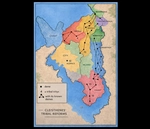
Nevertheless, this deliberate separation and fragmentation of the regional power blocs of the aristocrats—which did so much to set Athens upon the path of full democracy—were not motivated purely by altruism. As hath been stated earlier, Cleisthenes doth appear to have consolidated the dominance of his own family, the Alcmaeonids, in their strongholds, by his assignment of trittyes in Tribes 1, 7, and 10. Tribe 10 (Antiochis) doth furnish a sound example of this. The City trittys consisted of but a single deme, which, as archaeological evidence doth attest, was the city headquarters of the Alcmaeonids. Furthermore, the Coastal trittys on the south-west coast of Attica was in all likelihood their original home district, and the centre of the Alcmaeonid-led faction of the Paralia (The Coast) in the first half of the sixth century (599–550): Aristotle doth specifically state that the three former factions did take their name from the area in which they farmed (Ath. Pol. 13.5).
Albeit the Alcmaeonids were the predominant political force in the City and Coastal trittyes of Tribe 10, Cleisthenes did still manipulate the Inland trittys to his family’s advantage, by creating a long, attenuated trittys, stretching from the borders of the City to the north-east of Attica, with Mount Pendeli bisecting the trittys geographically into two. The denizens of this trittys had scant previous experience or knowledge of one another, would encounter difficulties in organising themselves, and, yet more importantly, would find it difficult to attend tribal assemblies in Athens: so disparate and divided a trittys would offer but little threat to the Alcmaeonids in tribal elections and business. Thus, Cleisthenes’ tribal reforms were a major—if not the most important—factor in the development of Athenian democracy, but they were also a means of improving the political standing of the Alcmaeonids at the expense of their opponents.