The Tyranny of the Peisistratids (The rule of the Peisistratids)
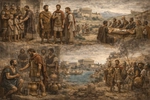
The Tyranny of the Peisistratids (The rule of the Peisistratids)
Peisistratus held dominion from approximately 547/6 B.C.E. until his demise in 528/7 B.C.E., during which epoch he maintained his grasp on power through a judicious amalgam of force, diplomatic acumen in his transactions with the aristocracy, and propitious policies directed toward the indigent.
The forces assembled by Peisistratus by the time of the Battle of Pallene vastly surpassed those of his aristocratic adversaries. The ensuing conflict witnessed the demise of several of his enemies, whilst those survivors who demurred from acquiescing to Peisistratus's governance departed into exile alongside the Alcmaeonids (Herodotus 1.64.3). Thus, the immediate peril posed by his most implacable foes was neutralized. Furthermore, to ensure the propriety of conduct amongst those aristocrats amenable to remaining in Athens and collaborating with his regime, he requisitioned their progeny as hostages, entrusting them to the custody of Lygdamis, the tyrant of Naxos (Herodotus 1.64.1). Finally, the disarmament of the populace and the retention of a mercenary force, financed through tax revenues and income derived from his commercial interests in Thrace, furnished him with the military means to enforce his will, should exigency demand.
However, Peisistratus, cognisant that a repressive regime predicated chiefly upon armed force would incite a vehement reaction from both the aristocracy and the plebeians, pursued a judicious policy:
Aristotle, Ath. Pol. 16.8–9
For in all matters he evinced a disposition to conduct the affairs of state in accordance with the laws, eschewing any claim to special prerogative … and by virtue of these actions, he retained power for a considerable duration, and, subsequent to his deposition [i.e. prior to 546 B.C.E.], he readily regained his authority. For the preponderance of notables and commoners alike favoured him, having been won over by the former through diplomatic finesse and the latter through his assistance in their private exigencies; he enjoyed widespread popularity.
By refraining from flaunting his power, Peisistratus circumvented the alienation of the aristocrats; and by permitting them to retain their status and prestige, he induced them to collaborate with his regime.
Thucydides (6.54.6) avers that the sons of Peisistratus ensured that one of their number invariably held office, which must be construed as signifying a member of their family or a political adherent; this, presumably, represented a continuation of their father's policy. [On]eto[rides] was likely nominated by Peisistratus prior to his demise, thus permitting him to hold the post of eponymous archon (chief archon). In the ensuing year, Hippias ensured his occupancy of the office to solidify his position as his father's successor as tyrant. It is the subsequent two names that divulge the extent of collaboration between the Peisistratids and the aristocracy. [C]leisthen[es] was the son and successor of Megacles, the Alcmaeonid chieftain of the 'Men from the Shore,' who had fled into exile in 546 B.C.E. following the Battle of Pallene. Herodotus (1.64.3; 6.123.1) conveys the impression – based most likely on information furnished by the Alcmaeonids – that the Alcmaeonids remained in exile throughout the duration of the tyranny, yet this inscription reveals that a rapprochement between the families had transpired. Similarly, Miltiades, son of Cimon, of the distinguished Philaid family, is unveiled as a collaborator. His father had also been exiled, but his dedication of his second Olympic victory, conceivably in 532 B.C.E., to Peisistratus (Herodotus 6.103) paved the way for the recall of himself and his lineage.
Peisistratus demonstrated sagacity vis-à-vis the aristocrats by permitting Solon's constitution to operate almost normally, or rather, almost as Solon had intended for the first time:
Aristotle, Ath. Pol. 16.2
Peisistratus, as previously stated [i.e. 14.3], administered the state in a moderate manner, and more constitutionally than as a tyrant.
Thus, it is reasonable to posit that the archons, the Areopagus, the Ecclesia, and the Boule of 400 discharged their functions, as stipulated by Solon, with minimal direct interference from Peisistratus. This semblance of normality would also appeal to the aristocrats, as their dignity and prestige would be publicly acknowledged, particularly in their tenure of the archonship and membership of the Areopagus, albeit their political power was, in reality, severely curtailed. This policy of non-interference on the part of the tyrants is corroborated by Thucydides:
Thucydides 6.54.5–6
These tyrants, for the most part, evinced virtue and intelligence in their policy … and in other respects, the city adhered to the laws that had been previously enacted, save insofar as they consistently ensured that one of their own held a place amongst the public officials.
It is evident that Hippias and Hipparchus, Peisistratus's sons, upon whom Thucydides was commenting, were pursuing their father's moderate policy. There exists no direct evidence to suggest that Peisistratus even confiscated the land of his exiled enemies; indeed, it is known that the property of Cimon, father of Miltiades, remained untouched during his exile (Herodotus 6.103.3), perhaps as an inducement to encourage his opponents to return. The fact that Cimon of the Philaids and Cleisthenes of the Alcmaeonids, two of the most distinguished aristocratic families in Athenian politics, and, presumably, other families politically aligned with them, returned to Athens under the Peisistratids, attests to the success of this policy of diplomacy and reconciliation.
The third element fundamental to the maintenance of Peisistratus's rule was his supportive policies for the poor:
Aristotle, Ath. Pol. 61.2–4
Moreover, he lent money to the poor for their husbandry, that they might earn a livelihood from farming. He did this for two reasons: firstly, to discourage their congregation in the city, dispersing them throughout the countryside; secondly, to ensure their relative affluence and engagement in their private affairs, thereby reducing their inclination and opportunity to attend to public matters. Concurrently, the cultivation of land augmented revenues, as he imposed a tax of 10 per cent ('decate') on the produce of the land.
Solon's cancellation of debts and his cessation of hectemoroi status had provided only temporary economic respite to the indigent farmers, yet he had done virtually nothing to furnish them with the means to ameliorate their financial position and thus avert a relapse into indebtedness. Peisistratus improved upon Solon's economic reforms by lending money to the impoverished farmers, thereby offering them positive assistance in several ways: whether to invest in their land, thereby augmenting its agricultural output; or to sustain themselves during the interim period whilst transitioning from cereal farming to the cultivation of olives and vines; or to tide others over until the rise of employment opportunities in industry enabled them to transition from farming, for his tax on agricultural produce encouraged those with capital to diversify and invest in industry. By the fifth century B.C.E., Athens possessed a widespread class of prosperous small farmers, much of the credit for which belongs to Peisistratus.
Aristotle, evincing his pro-aristocratic predilection, underscores the political motives underpinning the tyrant's munificent loans to the poor, which may have informed the formulation of this policy, albeit his motives appear anachronistic, i.e. post-democratic; but the attainment of economic security by the formerly impoverished farmers was a far more significant motive for the tyrant, as their resultant gratitude afforded a more secure means of retaining their loyalty. There exists a narrative that on one occasion, during his numerous tours of Attica wherein he consistently reviewed and adjudicated disputes, he observed a farmer toiling to cultivate a particularly stony patch of land. Upon Peisistratus enquiring of his attendant as to the land's yield, the farmer retorted acrimoniously 'aches and pains,' proceeding to lament the tyrant's 10 per cent tax on his meagre produce; Peisistratus forthwith exempted him from all taxes (Aristotle, Ath. Pol. 16.6). The veracity of this particular anecdote may be questioned, but not Peisistratus's frequent tours of inspection throughout Attica, which reveal his solicitude for the welfare of the poor. The 10 per cent tax, not particularly onerous in itself, was, in fact, likely only a 5 per cent tax, as it was under the rule of Peisistratus's sons (Thucydides 6.54.5), as the Greek word 'decate' was probably the traditional appellation for any 'tax'. Furthermore, to enhance the quality of life for the lower classes, he introduced local judges to remove the administration of law from the local aristocrats, thereby ensuring justice for the poor and emphasizing the state's superior position over the aristocrats (Aristotle, Ath. Pol. 16.5).
The foreign policy of Peisistratus and his sons also indirectly bolstered Athenian prosperity: pacific foreign relations engendered a propitious economic climate in which Athenians could fully exploit export markets:
Aristotle, Ath. Pol. 16.7
In general, Peisistratus occasioned the people no tribulation during his rule, consistently maintaining peace both domestically and abroad; consequently, the tyranny of Peisistratus was often termed the age of Cronus [i.e. 'a Golden Age'].
Peisistratus, unlike certain other tyrants such as Cleisthenes of Sicyon, did not rely upon an aggressive foreign policy to galvanize the populace behind his rule. He had already acquired allies in Greece during the period following his second exile from Athens, namely Eretria, Thebes, Argos, and Naxos; and during his tyranny, an alliance was likely forged with potent Thessaly, as strongly implied by the name of his third son, Thessalos. At some juncture, an alliance was also established with the Spartans, as disclosed in the speech of Cleomenes, King of Sparta, when he endeavoured to persuade his Peloponnesian allies to reinstate Hippias as tyrant of Athens (Herodotus 5.91), though this may have been formed during Hippias's rule. It would appear that Peisistratus generally preferred to secure peace by forging diplomatic links with foreign powers; yet this did not preclude him from employing force when he deemed it to be in Athens's or his own interests. This dual policy of diplomacy and force proved highly effective in foreign affairs.
One of the initial acts of his rule was to attack Naxos and install Lygdamis, his ally, as tyrant (Aristotle, Ath. Pol. 15.3). Athens's position in the Aegean and prestige amongst the Ionian states were further augmented by Peisistratus's religious purification of the island of Delos (Herodotus 1.64.2) – Delos being the venue for an Ionian festival encompassing athletics, poetry, and music, in which the cities of Ionia, the islands, and Athens participated (Thucydides 3.104). Sigeum, occupying a strategically significant position on the Ionian mainland proximate to the Hellespont, was forcibly recovered from Mytilene by Peisistratus, who installed a son, Hegistratus, as ruler (Herodotus 5.91.5). Furthermore, Miltiades became the ruler of the Dolonci in the Chersonese, the peninsula situated on the western flank of the Hellespont. Although Herodotus asserts that dissatisfaction with Peisistratus's rule was a prominent motive for Miltiades's acceptance of the Dolonci's invitation (6.34–35.3), it is far more probable that this colony was founded with Peisistratus's full approval, as colonists could not be removed from Athens without his consent, and its strategically crucial position near the Hellespont, complementing Sigeum on the opposite eastern side, would have been welcomed by the tyrant. Thus, a combination of pacific relations with foreign powers and domestic political stability provided the bedrock for a widespread improvement in the standard of living of the Athenians during the latter half of the sixth century B.C.E.