The Peisistratids' Buildings
The Peisistratids' Buildings
It doth occasion some surprise that Aristotle, in his treatise *Athenaion Politeia*, maketh no mention of those two enduring achievements attributable to the Peisistratids: first, that programme of public works which furnished employment to the poorer citizenry; and second, the encouragement of religious festivals and the patronage of the arts, thereby emphasising the unity of Attica through the diminution of local cults and by directing attention toward Athens as the social, religious, and cultural (as well as political) centre of the Athenian state.
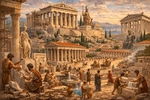
The Peisistratids did preside over the most substantial building programme in archaic Athens. Natheless, it proveth arduous to ascertain, from the architectural relics and the uncertain dating based on artistic style, the precise epoch at which the major edifices were commenced or brought to completion; and thus, whether certain building projects were initiated prior to the tyranny, or, if undertaken during the tyranny, whether credit be due to Peisistratus himself, or to his sons. This quandary is further complicated by Peisistratus's two periods of tyranny and exile in the mid-sixth century, prior to his finally securing power for himself and his progeny from 547/6 to 511/0. Such limitations upon our knowledge must be borne in mind throughout the ensuing discussion.
Albeit there exists scholarly discord regarding the extent of building construction undertaken upon the Acropolis during the tyranny and the final decade of the century, the preponderant view amongst scholars holds that Peisistratus and his sons ought to receive full credit for the sixth-century Acropolis structures, particularly as the funding of religious edifices served as an efficacious political stratagem; the rebuilding of the Temple of Apollo at Delphi by the Alcmaeonids furnish a salient exemplar. The most prestigious building was the old temple of Athena Polias, whose extant stone rectangles on the north side of the Acropolis are known as the Dorpfeld foundations. Some scholars do contend that these foundations were first laid circa 525, when the sons of Peisistratus authorised the construction of this temple; others argue that these foundations were laid in the first half of the sixth century (599–550) for an earlier temple, which was rebuilt in the last quarter of the sixth century (525–500) upon the selfsame foundations.
The dating, by most scholars, of the surviving pedimental sculptures – the lions, Heracles and Triton, and Bluebeard (Hurwit, pp. 240–41) – to the 560s, coupled with other religious and political occurrences of that era, doth furnish more compelling evidence for the earlier date. The commencement of the construction of a temple dedicated to Athena in the 560s would accord well with the introduction (or the significant development) in 566 of the most pre-eminent religious festival in the Athenian calendar, the Great Panathenaea, which honoured Athena as the patron goddess of Athens and underscored the unity of the state. The 560s also witnessed the ascent of Peisistratus as an influential political leader, who took especial care to identify himself publicly with Athena, even venturing so far as to assert that the goddess herself was escorting him to power in his second endeavour to become tyrant. Therefore, it is plausible that, after the decision was taken (with the probable endorsement of Peisistratus) to construct the temple and the foundations were laid in the 560s, the political tribulations of Peisistratus in the 550s retarded its construction, and that the temple, replete with its pedimental sculptures, was not finally completed until after Peisistratus's third and final seizure of power in 547/6 – should this be the case, then this temple was renovated by his sons circa 525. The other edifices upon the Acropolis, which were almost assuredly constructed under Peisistratus's direction, were the cult temple of Artemis of Brauron, his home district upon the east coast of Attica, and the first small treasury-style buildings (‘oikemata’).
The Agora also commenced to take shape under Peisistratus as the civic centre of Athens with the removal of houses and the abandonment of wells. Towards the south-west corner, a substantial edifice was erected, known as Building F and dated circa 550–525. It comprised a central courtyard, which was encircled by a number of rooms upon three sides. This large and imposing structure doth convey the impression of being both a private residence, albeit of too grand a scale to be an ordinary dwelling, and an official public building: thus, it is believed to have been the ‘palace’ of Peisistratus. This would be in accordance with his aspiration to render the Athenian Agora, together with the Acropolis, the political, social, and cultural hub of Attica. Two shrines were also erected upon the west side of the Agora in honour of Zeus Agoraios and Apollo Patroos. If their construction was intended to symbolise the union of the state, then this constitutes further evidence of Peisistratus's deliberate policy of employing religious cults to focus the minds of the populace upon Athens as the centre of a unified state.
The Royal Stoa, from whence most of the state cults and the law courts were administered, was possibly constructed at this time upon the west side. Yet the most ambitious project of all was the erection of the Olympieion, a temple dedicated to Olympian Zeus, who was Athena's sire. This was the largest temple to be attempted in Greece up to that juncture, and, according to Aristotle (*Politics* 1313b), was begun by the Peisistratids. The undertaking was of such immensity that not even his sons, whom some scholars believe were responsible for the project, completed its construction; this task was left to the Roman emperor Hadrian circa AD 132. Peisistratus also built a temple upon the eastern side of Mount Hymettos, and added a colonnade to the temple of Athena at Cape Sunium.
Peisistratus's ambitious building programme was continued by his sons and grandson:
Thucydides 6.54.5
They [i.e. Hippias and Hipparchus] adorned their city beautifully, brought their wars to a successful conclusion, and offered sacrifices at the sanctuaries.
They either initiated the building of the temple of Athena Polias or authorised its renovation. The original outer colonnade was replaced by a new and higher one, and the superstructure was also completely renewed. Furthermore, not only was the new so-called east pediment free-standing and executed in marble, unlike the other older pediment, sculpted in relief and executed in limestone, but also there was a dramatic new theme, namely the Gigantomachy, i.e. the battle between the giants and the gods for supremacy. Athena was accorded the dominant position in the pediment, which doth demonstrate that Peisistratus's sons were continuing his policy of emphasis upon Athena and Athens. The old Propylon, the entrance to a temple, may also have been built around the same time, since it faces the temple of Athena Polias and not the Older Parthenon, whose construction was begun after the battle of Marathon in 490.
The Peisistratids also set their minds to improving the infrastructure of Athens. Hipparchus is credited with improving communications throughout Attica by setting up ‘hermai’ (images of Hermes, the patron god of travellers) to act as milestones on the roads (Plato, *Hipparchus* 228d). Peisistratus, the tyrant's grandson and son of Hippias, also dedicated an altar of the Twelve Gods, from which all distances from Athens were marked; it has been located archaeologically upon the north side of the Agora. He was also responsible for the building of an altar of Apollo in the sanctuary of Pythian Apollo, which bore an inscription recording his dedication (Thucydides 6.54.6–7). The accuracy of Thucydides's quotation has been confirmed by the discovery of two fragments in 1877:
ML 11
This memorial of his archonship Peisist[ratos s]on [of Hippias] dedicated in the precinct of Pyth[i]an Apollo.
The position of the two fragments in the south-east of the city marked the location of the sanctuary of Pythian Apollo.
The sons of Peisistratus also undertook a major improvement of Athens' water supply. Two pipelines, conveying water from the hills east of Athens, were laid circa 520 to run along the north and south slope of the Acropolis. The northern pipeline ended at a very large fountain-house, known as the ‘Enneakrounos’ (‘the Nine Spouts’); and the southern one ended at another fountain-house in a residential area south-west of the Areopagus. The popularity and frequency of use of these fountain-houses are attested by their inclusion upon numerous late sixth-century vases. At Eleusis, they rebuilt the ‘Telesterion’ (the Hall of the Mysteries) upon a larger scale, and strengthened the walls of the sanctuary. This sanctuary at Eleusis was one of the most important in Attica, and its growing popularity and the increased attendance at the ceremonies during the sixth century provided a practical reason for building the larger hall. However, this building work was also motivated by a desire to compete externally with other pan-Hellenic sanctuaries and internally with the local cults throughout Attica: the celebration of the Great Mysteries stressed the unity of Attica, symbolically demonstrated by the annual pilgrimages from Athens which were attended by large numbers of Athenians.