The Reforms of Cleisthenes, Development of Athenian Democracy
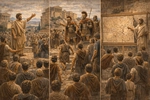
The Reforms of Cleisthenes, Development of Athenian Democracy
There exist no contemporary literary sources pertaining to the reforms of Cleisthenes. Herodotus, writing some sixty to seventy years post the affair, evinces but a cursory interest in the constitutional reforms, concentrating his narrative more on the sequence of historical events (5.66, 5.69–73.1). Aristotle’s (or, perchance, his pupil’s) Ath. Pol., penned in the third quarter of the fourth century (349–325), encompasses not only the historical narrative (Ath. Pol. 20.1–3) but also elucidates Cleisthenes’ reforms in some detail (Ath. Pol. 21–2). The initial portion of Aristotle’s account, detailing the political rivalry between Cleisthenes and Isagoras, the intervention of the Spartan King Cleomenes in Athens, and the ultimate triumph of Cleisthenes, serves as a précis of Herodotus, manifestly grounded in his work. However, the subsequent portion, concerned with the constitutional reforms, contains particulars absent from any other extant source, intimating that his intelligence derives from one of the fourth-century Atthidographers who authored histories (typically biased) of Athens.
It doth appear that there existed no immediate political perturbations following the expulsion of Hippias the tyrant, likely attributable to the fact that the Peisistratids had, for all intents and purposes, left Solon’s constitution inviolate, save for securing their dominion over the archonship (Thucydides 6.54.6). However, within a few years, a grave political clash ensued between two aristocratic-led factions, one under the leadership of the Alcmaeonid Cleisthenes and the other under Isagoras.
There exists no means of ascertaining how many other puissant families participated on either side, or if other factions existed; yet these two were assuredly the dominant political forces of the epoch. Their contention over the archonship – presumably the ex-archon Cleisthenes sought to forestall Isagoras’ election – and consequently membership of the Areopagus, the redoubtable aristocratic council, is reminiscent of the rivalry and in-fighting amongst the aristocratic leaders and their factions in the first half of the sixth century (599–550): manifestly, both Cleisthenes and Isagoras regarded the post-tyranny situation as an opportunity to revert to the conventional pre-tyranny style of politics. This perspective is bolstered by the absence of any mention of a conflict of political principle between the two leaders, and the assertion or strong implication in both principal sources that they were aided by their ‘hetairoi’ (aristocratic supporters). Ergo, the initial clash constituted an old-fashioned power struggle between two ambitious faction leaders, wherein conflicting ideologies regarding the nature of the constitution played no part.
The spark that ignited the troubles was the election of Isagoras to the office of eponymous (chief) archon for 508/7, at the expense of the favored candidate of Cleisthenes and his faction. Thereupon, Cleisthenes adopted a novel approach to fortify his political power-base. The tyrants had already demonstrated that the common people constituted a valuable political asset in any struggle for power, and Cleisthenes resolved to emulate their example:
Herodotus 5.66.2, 69.2
These men [i.e., Cleisthenes and Isagoras] were striving with their factions for power; and when Cleisthenes was getting the worst of it, he added the people to his faction (66.2). … For when he had added the people of Athens, whom he had previously ignored, to his faction, he changed the names of the tribes and increased their number. He created ten ‘phylarchs’ (tribal leaders) instead of four, and distributed the demes among the tribes. By winning over the people he became much stronger than the rival faction (69.2).
Herodotus manifestly held the view that political opportunism served as the dominant motive behind Cleisthenes’ courting of the Athenian people, yet he fails to explicate how Cleisthenes won over the people and how he employed them against Isagoras.
The broad answer to the first query – concerning the means employed by Cleisthenes to secure the support of the people – likely lies in Aristotle:
Aristotle, Ath. Pol. 20.2
Cleisthenes brought over the people to his side by handing over the control of the state to the common people (‘plethos’).
Cleisthenes was unlikely to have furnished a detailed explanation of his proposed tribal reforms, which would have been excessively arduous for the ordinary Athenian to comprehend, owing to their complexity. Therefore, he likely emphasized the principal tenet or the essence of his reforms: that henceforth, all major political decisions would be rendered by the ordinary people in the Ecclesia (Assembly). He likely also divulged sufficient information regarding the beneficial effects of the tribal reforms for those who had been recently disenfranchised, thereby securing their backing for his proposals by engendering hopes of regaining their Athenian citizenship. The answer to the second query is more challenging; it is conceivable that he put the motion as a private citizen before the Ecclesia or, more probably, he enlisted the support of the ‘Boule of 400’ (Council of 400), whose function it was to prepare motions for decision by the Ecclesia.
These proposed reforms were put before the Ecclesia shortly before or just after the election of Alcmaeon to the archonship of 507/6 – manifestly, from his name, a kinsman of the Alcmaeonid Cleisthenes. The success of Cleisthenes’ democratic legislation and the election of his political enemy’s protégé to the top post proved excessively burdensome for Isagoras – he summoned King Cleomenes of Sparta.
Cleisthenes departed from Athens before Cleomenes arrived in Athens with a small force and expelled seven hundred families, selected by Isagoras. However, Cleomenes’ subsequent move proved injudicious:
Herodotus 5.72.1–2
He then tried to dissolve the Council (boule) and entrusted the offices of state to 300 of Isagoras’ faction. When the Council resisted him and was not willing to obey his orders, Cleomenes and Isagoras together with his political supporters seized the Acropolis. But the Athenians united and besieged them for two days; on the third day all those who were Spartans departed from the country under a truce.
Herodotus doth not elucidate whether it was the aristocratic council, the Areopagus, or the Boule of 400 that Cleomenes attempted to dissolve. The Areopagus was a highly prestigious institution, owing to its venerable age and the prestige of its members, and its dissolution would have been a radical step. Furthermore, it likely contained numerous members who, like Isagoras, had acquiesced in the regime of the Peisistratids, and supported or belonged to Isagoras’ faction. The Boule of 400 seems a far more likely candidate for dissolution, especially if it put the motion for democratic reform to the Ecclesia (Assembly) on behalf of Cleisthenes. The surrender and departure of the Spartans and Isagoras from Athens led to the return of Cleisthenes and the 700 families from exile, to the archonship of Alcmaeon in 507/6, and to the implementation of the reform programme.