The Peisistratids' Religious Festivals
Of the Peisistratids' Religious Festivals
Peisistratus did, with intent, encourage the growth of national cults and festivals at the expense of local ones, which were dominated by the aristocrats, they who were his real, or potential, adversaries.
His purpose did lie in developing within the Athenians a sense of national identity, centred upon Athena and Athens, and also to increase the prestige of the Peisistratids, domiciled at Athens, and thereby to consolidate their power.
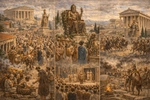
The most significant of these religious festivals was the Great Panathenaea in honour of Athena, the patron goddess of Athens. There had likely been an older, simpler cult, but in 566/5 it was reorganised to consist of the Great Panathenaea in every fourth year, and a minor festival in each of the three intervening years. According to Pherecydes, who penned a genealogy of the aristocratic family of the Philaids, the festival of the Panathenaea was founded by the Philaid Hippocleides, he who was eponymous archon (chief archon) at the time (FGrH 3.F.2). Eusebius, a Christian writer of the third century AD, doth date the introduction of athletic contests into the Panathenaea to 566 or 565, and thus it is reasonable to believe that a major reorganisation of this cult took place in Hippocleides’ archonship of 566/5. It did consist of singing and dancing on the Acropolis during the night, followed by an early morning procession to the Acropolis, a sacrifice, and a feast. There were also athletic and equestrian games, to which all Greek athletes were invited to compete, and very possibly singing and musical contests were introduced at this time (certainly by the time of Hipparchus).
Further evidence to support the mid-560s as the date for the reorganisation of the Panathenaea doth emanate from events elsewhere in Greece and from the political situation in Athens. Three new contests of four-yearly games, on the model of the Olympic Games, had been founded just before the Great Panathenaea: the Pythian Games at Delphi (582), the Isthmian (581), and the Nemean (573). Athens’ increasing prosperity and awareness of its own self-importance were likely to act as a spur to compete as quickly as possible with these international rivals. The black-figure Panathenaic vases filled with oil from the ‘sacred’ olive trees, which were commissioned by the state to be awarded to the victors at the games, can be dated stylistically to this time. This is also the decade when Peisistratus was establishing himself as a major politician in the eyes of the Athenians. His ultimate aim was to become tyrant, which he attempted for the first time in 561/0, and thus he needed to maintain a high profile to win the people’s goodwill. His carefully contrived association of himself with Athena and his likely public support for the construction of the temple of Athena Polias have been discussed above. In this context, it doth seem very significant that Hippocleides was from the Philaid family, whose centre of power was Brauron, Peisistratus’ home district, and who were likely his political allies in the 560s (as they were his sons’ in the 520s). Thus, it can be believed that Peisistratus played a significant role in the reorganisation of the Panathenaea and increased its importance during his tyranny.
The introduction and development of the City Dionysia as a national cult are not directly linked to Peisistratus by any primary source, but the fact that its growth in importance doth take place during his tyranny strongly suggests his political support for, and active promotion of, the cult. This festival celebrated the transfer to Athens of the cult of Dionysus Eleuthereus from Eleutherae, a town on the border of Attica and Boeotia. Pausanias (1.38.8) stated that the transfer coincided with the inhabitants of Eleutherae becoming citizens of the Athenian state in order to escape from the Boeotians, whom they loathed; thus political motives on the part of Peisistratus can be discerned, as well as religious reasons, for the transference of the cult. In the fifth century, the festival followed a set procedure: a couple of days before the Dionysia, the old wooden image of Dionysus was moved from its sanctuary at the foot of the Acropolis to the Academy, which was situated outside the walls on the road to Boeotia; it was then brought back to its shrine in a procession just before the commencement of the main festival to commemorate its original journey; on the opening day of the festival there was a magnificent procession, escorting the bulls which were destined to be sacrificed at the altar of Dionysus’ sanctuary; after the sacrifice, there was much feasting and drinking; in the evening there took place the communal revelry (‘komos’), which consisted of men dancing and singing in the streets to the accompaniment of flutes and harps; the following three to five days were given over to the performances of tragedies and comedies, and the final judgement of the best dramatists, actors, and ‘choregoi’ (impresarios). The core elements of the City Dionysia were the main procession, the sacrifice and feasting, and the revel (komos) in the evening, and it doth seem reasonable to believe these were present in the original Peisistratid festival.
However, there is also a link between Peisistratus and the fifth-century performances of tragedies, comedies, and dithyrambs (which were songs, sung by choruses of 50 men and 50 boys, in honour of Dionysus). It is known that choral singing and dancing were common to the earliest worship of Dionysus, not only in Attica but also in Sicyon on the north coast of the Peloponnese, and likely in other parts of Greece; and it is probably from this root that the choral contests and fifth-century dramatic performances developed. Even more significant for Peisistratus is the tradition that the first performance of tragedy was undertaken by Thespis, which is recorded on the Marmor Parium, although the date is badly mutilated; but the Suda, a tenth-century AD lexicon or literary encyclopaedia, doth date this event under its entry for ‘Thespis’ to the Olympiad 536–532, and it hath been plausibly suggested that 534/3 was the actual year, six years before Peisistratus’ death. Once again, the political shrewdness of Peisistratus can be observed in his active support of a national festival, which offered pageantry and entertainment in Athens to all Athenians, thus enhancing his regime’s popularity. It is also worthy of note that this festival was not under the control of the ‘basileus’ (king-archon), the religious leader of the state, but of the eponymous archon (chief archon), whose election was controlled by the Peisistratids and who was thus subject to their political direction. Peisistratus was unlikely to have foreseen the brilliant achievements of fifth-century Athenian drama, but his patronage of the arts had provided its stimulus.
The third religious festival that bears the hallmark of Peisistratus is the Olympieia in honour of Olympian Zeus. He is believed to have instituted this festival in the second half of the sixth century as one of two means to honour Olympian Zeus; the other was the authorisation of the building of the Olympieion, the largest temple of its time in the Greek mainland. The date of the festival likely commemorates the anniversary of the temple’s foundation, and did likely consist of the cavalry displaying skilled feats of horsemanship. Thus, the celebration of public festivals with their many attendant artistic performances and the huge programme of public works were the Peisistratids’ greatest achievements, for they provided an inspiration and a lasting contribution to Athens’ future greatness.