The reforms of Solon (Economic reforms)
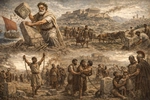
The Reforms of Solon (Economic Reforms)
An account of the economic reforms enacted by Solon to address the prevailing crisis is furnished in Aristotle’s *Ath. Pol.* (6–12) and Plutarch’s *Life of Solon* (15–25).
The essence of Solon’s economic reforms is articulated in his own self-laudatory verse:
Solon fr. 36 in Aristotle, *Ath. Pol.* 12
Did I desist before I had achieved all of the aims for which I convened the populace? May the mighty mother of the Olympian gods in the court of Time be my foremost witness, the Black Earth herself, from whom I removed the marker-stones (*horoi*) imposed in sundry places: erstwhile she was a slave, now she is free. I brought back to Athens, to their divinely-built homeland, those numerous men who had been sold abroad, some unlawfully, others lawfully, and those who had been compelled into exile through pressing debt/dire necessity, no longer employing the Attic tongue, as they had wandered in so many locales. I also liberated those at home who were in shameful servitude and trembled before their masters’ caprices. These deeds I effectuated, uniting perfectly together force and justice; and I executed them as I had promised.
The most exigent problem was the economic and social plight of the lower classes, and Solon’s overwhelming predilection for social justice rendered this reform the centre-piece of his legislation. This facet of his reform programme is elucidated more fully by Aristotle:
Aristotle, *Ath. Pol.* 6.1
Solon, having attained full command of Athenian affairs, set the people free both in the present and for the future by rendering it unlawful to grant loans on the security of the person, and he enacted laws, and he carried out a cancellation of both private and public debts, which was styled the ‘Seisachtheia’ (the Shaking off of Burdens) as the people shook off their heavy load.
Although these two sources do not furnish a comprehensive explication of Solon’s economic measures, a combination of both plausibly suggests that he instituted three major reforms. In the first instance, he abolished the class of *hectemoroi* by removing the marker-stones (*horoi*). These stones were employed in the fourth century as a public symbol of land being under some constraint, and presumably at the time of Solon their function was to identify the land of the *hectemoroi* and thus their obligations. Solon had now ‘freed’ the land and granted them full possession thereof, thereby adding substantially to the class of small landowners. Indeed, it would seem from the opening lines of Solon’s poem that they were the main beneficiaries of his cancellation of debts. This is not to gainsay what was stated above regarding the origins of the *hectemoroi*, *viz.* hereditary serfdom, since ‘*chreos*’ – the Greek word that is translated by ‘debt’ – has a broader signification than simply being in debt from borrowing: it is employed to describe any situation wherein someone is dependent or under obligation, such as the payment of rent or taxes or other dues. Certain scholars have found this difficult to accept, believing that the *hectemoroi* tilled the land of the rich and stressing Solon’s words (fr. 34 in Aristotle, *Ath. Pol.* 12.3) that he did not effectuate a redistribution of land. However, if it is accepted that the conditional tenure of the land led to no clear-cut identification of ownership (discussed above), then the removal of the one-sixth obligation resolved the ambiguity once and for all: the newly freed former *hectemoroi* were now without question the legitimate owners of the land.
The second reform, albeit hard to imagine in practice, set about repatriating those Athenians who had either been sold abroad or fled into exile. These Athenians would have been those identified by Aristotle (*Ath. Pol.* 2) as *agogimoi*, *viz.* liable to seizure: *hectemoroi* who had failed to pay their one-sixth and borrowers who had used their own person as security. The third reform was the cancellation of debts, thereby liberating the debt-bondsmen in Attica, and the prohibition of any debt that involved the pledge of the person as security. Thus no Athenian in the future could become a debt-bondsman or be sold into servitude for debt.