The Ecclesia (Assembly)
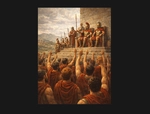
All male Spartiates, or ‘Homoioi’ (the Peers/the Similars), as they styled themselves, were eligible to attend the Assembly (Ecclesia), which the Great Rhetra, in section (2), authorised to be held at regular intervals, that is to say, at the time of the festivals in honour of Apollo called the ‘Apellai’. They possessed the right to elect the members of the Gerousia and the Ephors; and, moreover, held the sovereign power to ratify or reject the proposals laid before the Assembly by the Gerousia. Section 3 of the Great Rhetra, which addresses this constitutional power, is rendered obscure, likely owing to the difficulty encountered in transcribing the passage written in an archaic Doric dialect, yet Aristotle’s commentary, preserved by Plutarch, concerning this particular constitutional right is exceedingly precise:
Plutarch, Life of Lycurgus 6.3:
When the populace have convened, none other is permitted to advance a motion, but the populace retains the sovereign power to adjudicate upon the motion set before them by members of the Gerousia (‘gerontes’) and the kings.
Much scholarly debate has arisen as to whether the Spartiates actually wielded this power of decision-making. Aristotle, in the Politics, whilst discussing the democratic features inherent in the constitutions of Carthage, Crete, and Sparta, expresses the sentiment that the Carthaginian constitution is the more democratic:
Aristotle, Politics 1273a 9–13:
And when these [Carthaginian] kings proffer their proposals, they not only permit the populace to attend to the proposals that have been decided upon by their rulers, but the populace possesses the sovereign power to decide (‘krinein’); and any who desire to speak against the proposals introduced are at liberty to do so, a circumstance not possible in the other constitutions [viz., those of Sparta and Crete].
Certain historians opine that the final clause – ‘a circumstance not possible in the other constitutions’ – alludes to the dual powers vested in the Carthaginian Assembly, namely, the power to decide and the power to debate. However, should the final clause be interpreted as pertaining solely to the latter power (the power to debate), then Aristotle is positing that the Spartan Assembly held the sovereign power to ratify or reject all proposals (krinein), but was not permitted to debate them. Through this interpretation of the final clause, the statements contained within the Great Rhetra and Aristotle’s Politics may be regarded as being in accord: the Spartan Assembly possessed the sovereign power of decision.
This gives rise to a further area of scholarly contention: whether the ordinary Spartan enjoyed the right to engage in debate. Three perspectives exist upon this matter. The first (e.g., Andrewes) avers that the Spartans, within their Assembly, possessed the right to debate the Gerousia’s proposals, citing Aristotle’s commentary on the Rider (section 4) of the Great Rhetra as supporting evidence:
Plutarch, Life of Lycurgus 6.4:
Subsequently, however, when the populace were distorting and twisting the proposals by appending and deleting words, the kings Polydorus and Theopompos inserted this clause into the rhetra: ‘but if the damos [the people] speaks crookedly, the Gerousia and the kings are to be the removers’.
The very fact that the populace were altering the proposals presupposes the existence of debate, and that amendments, or even counter-proposals originating from the floor, were drastically modifying the original decisions of the Gerousia; consequently, Aristotle’s statement cited above in the Politics (1273a) is erroneous.
The second viewpoint (e.g., Forrest) maintains that Spartan decision-making comprised two stages. In the first stage, the Gerousia presented the issue to the Assembly, which was permitted to debate; once the arguments had been heard, the Gerousia would retire and formulate its final proposal so as to reflect the prevailing majority view. The second stage would consist of the Gerousia submitting its proposal for ratification, without any further debate being permitted, and it is this second stage to which Aristotle may have been alluding in the aforementioned quotation from the Politics. The third viewpoint (e.g., de Ste. Croix) contends that Aristotle’s statement in the Politics is substantially correct, provided it is accepted that no ordinary Spartan possessed an absolute constitutional right to speak in the Assembly, but was granted the opportunity to speak if so invited by the presiding Ephor.
Aristotle, in the quotation above (Plutarch, Lycurgus 6.3), states plainly that no ordinary Spartan was permitted to advance a motion, but solely to vote upon the Gerousia’s proposals. The Rider (section 4) was appended by Polydorus and Theopompos, who invoked the authority of the Delphic oracle, because, notwithstanding the absence of debate, the wording of the proposals to be voted upon was being altered in the Assembly. Whenever this occurred, the Gerousia now possessed the right to reject this alteration to its original proposal and to dismiss the Assembly.