The First Messenian War
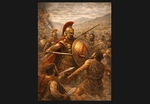
This war may be reliably dated to circa 730 to 710 BC, and was prosecuted by the Spartans against their Dorian brethren inhabiting and possessing the fertile lands of Messenia in the south-western Peloponnese. The dating of this conflict is corroborated by the writings of Tyrtaeus, a Spartan poet flourishing around the mid-seventh century, and the Olympic victor lists. Tyrtaeus situates the war during the reign of King Theopompos, two generations prior to his own era:
Tyrtaeus fr. 5:
to our king, the friend of the gods, Theopompos, through whom we captured widespaced Messene; Messene good for ploughing and good for planting, over which they fought – the spearmen fathers of our fathers – for nineteen years, always unceasingly and with an enduring spirit; and in the twentieth year the enemy, leaving behind their fertile lands, fled from the great heights of Ithome.
Furthermore, the Olympic victor lists enumerate seven Messenians from 777 to 736, with but a solitary subsequent entry; conversely, the Spartans secure their inaugural victory in 720 and dominate the lists until 576.
It remains uncertain whether the Spartan triumph in the First Messenian War resulted in the complete annexation of Messenia, or merely the eastern moiety, viz. the fertile terrain encompassing the valley of the River Pamisos, which flows due south into the Messenian Gulf. Certain conquered Messenians sought refuge in disparate regions of Greece, most assuredly in neighbouring Arcadia, extending succour to the Messenians in their revolt against Sparta during the seventh century. The remainder were compelled to labour for their Spartan overlords:
Tyrtaeus fr. 6:
Just like asses, worn out by their mighty burdens, they bring to their masters through wretched necessity a half of all the fruit that the land brings forth.
This precipitous augmentation of territory engendered immense economic prosperity for sundry Spartans, albeit not universally. A faction of Spartans harboured profound discontent regarding the apportionment of spoils from a protracted and arduous war: the ‘Partheniai’. The precise distinctions separating them from other Spartans remain obscure, yet they were evidently regarded as an inferior cohort within the body politic, and discrimination incited revolution within their ranks (Aristotle, Politics 1306b 29–31). Colonisation, previously employed by other Grecian states as a safety valve to mitigate social tensions (Plato, Laws 735f), was adopted by Sparta on this singular occasion, dispatching the Partheniai as colonists to establish Taras (Tarentum) in southern Italy circa 706. It would appear that their status as inferior citizens, compounded by their failure to acquire land in the aftermath of the Messenian War, constituted the principal grievances of the Partheniai. Their discontent has garnered considerable attention in ancient sources, yet there is ample justification to posit that other Spartans were similarly aggrieved by the inequitable distribution of land, both in Laconia and, especially, in the newly acquired (or portion thereof) Messenia.
Numerous later sources, buttressed by Spartan propaganda, played a pivotal role in the genesis of the Spartan myth – the idealisation of Sparta as the quintessential, well-ordered society, perpetually immune to the civil strife (stasis) that profoundly scarred numerous other Grecian states; and the attribution of the radical political, social, and economic reorganisation of Sparta to the legendary law-giver, Lycurgus. Nevertheless, Herodotus did not subscribe to the myth of perpetual Spartan eunomia (good order/under good laws):
Herodotus 1.65:
before this they were the worst governed (‘kakonomotatoi’) of virtually all the Greeks, having no dealings with each other or with strangers.
This depiction of an earlier Sparta, beset by internal discord, is further corroborated by Thucydides:
Thucydides 1.18.1
For although Lacedaimon … had civil strife (‘stasiasasa’) for the longest period of time that we know, nevertheless it acquired ‘good order’ earlier than any other state and has always been free from tyrants.
The military success against Messenia and the subsequent unfair land distribution would have exacerbated the tensions which already existed in Sparta and which were manifesting themselves in other Greek states in the eighth and seventh centuries: the inequality in the size of land-holdings and the injustice of aristocratic government.
Events in the second quarter of the seventh century (675–650) brought these problems to a head. The Spartans, emboldened by their defeat of the Messenians, resolved to challenge the power of the Argives, and attempted to seize control of the fertile Thyreatis, the area in the north-eastern Peloponnese demarcating their respective spheres of influence. The battle of Hysiae in 669 (Pausanias 2.24.7) culminated in a crushing defeat for the Spartans, very possibly inflicted by the newly constituted ‘hoplites’ under the command of King Pheidon of Argos. Military defeat would have intensified discontent within Sparta, precipitating renewed demands for land reform. According to Pausanias, King Polydorus, reigning from circa 700 to 665, espoused the grievances of the common Spartan and advocated some form of land distribution, but was assassinated by the aristocrat Polemarchos before his proposals could be implemented. The overwhelming military defeat at the hands of the Argives and the burgeoning political discord within Sparta almost certainly spurred the Messenians to rise in revolt.