The rise of Sparta in the sixth century
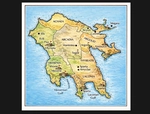
Towards the close of the sixth century (599–500), the Spartans had, throughout the Peloponnese, established a series of military alliances, wherein they were acknowledged as the ‘hegemon’ (leader) of a military league, denominated the Peloponnesian League by modern scholars. However, owing to the paucity and unreliability of extant sources, it is exceedingly difficult to trace with precision the stages of the League’s development. Herodotus furnishes the briefest of information concerning Sparta’s expansion in the first half of the sixth century:
Herodotus 1.65:
During the kingship of Leon and Agasicles at Sparta, the Lacedaimonians prospered in their other wars, yet consistently failed against the Tegeates.
Leon and Agasicles reigned from circa 580 to circa 560, but, save for the conflict between Sparta and Tegea (vide infra), little is known respecting these successful ‘other wars’. The sole ‘other’ war that can be attributed with any confidence to this period is Sparta’s intervention on behalf of the Eleans, who vanquished the Pisatans in circa 572 and regained dominion over Olympia. This military alliance with Elis was purposed to deter the Pisatans, who occupied the territory bordering upon northern Messenia, from affording succour to the Helots. The Spartans also garnered a reputation as expellers of tyrants in the sixth century (Thucydides 1.18), and it is conceivable that the Spartans played a role in the overthrow of the Cypselid tyranny in Corinth (circa 583) and the Orthagorid tyranny of Sicyon (circa 556). However, the catalogue of Sparta-aided expulsions of tyrants from such late sources as Plutarch, Moralia 859c–d, does not inspire confidence; and it would be strategically more judicious to subdue Tegea and Argos on their northern borders before embarking upon such campaigns further north.
Two powers stood athwart the Spartans establishing their supremacy in the Peloponnese: Tegea and Argos. The Tegeates had aided the Messenian Helots in the Second Messenian War, and would invariably offer them, in future, either encouragement to revolt or a refuge for escape, unless checked. The Argives had inflicted a severe defeat upon the Spartans at Hysiai in 669 and had established themselves as one of the principal powers, if not the foremost, in the Peloponnese. The Spartans elected as their first target the city-state of Tegea, the strongest and most influential of the Arcadians. This was imperative, owing to the perpetual menace of an Arcadian-inspired Helot revolt, and because it would be perilous to launch an attack against Argos without previously ensuring that their left flank would not be exposed to an attack by unconquered Arcadians. Therefore, in the first half of the sixth century, the Spartans set about the conquest of Tegea, which, if successful, would bring the remainder of Arcadia under their control.
It is evident from Herodotus’ quotation above that the Spartans encountered the greatest difficulty in their attempt to subdue Tegea. According to Diodorus (Book 7 fr. 13.2), the Spartans’ first campaign culminated in failure when the Tegeates, aided by the Argive forces of King Meltas (grandson of Pheidon), even regained some lost territory. Far more grievous was their defeat at the ‘Battle of the Fetters’. So assured were the Spartans of attaining complete victory, sanctioned by the Delphic oracle, that they even brought fetters with them to place upon the vanquished Tegeates; ironically, it was the Tegeates who made use of the fetters, placing the Spartans in chains and compelling them to till the fields of Tegea (Herodotus 1.66). The intention of the Spartans is revealed by the fact that they brought fetters and measuring-rods on this campaign – to transform the Tegeates into Helots and to apportion their territory into more cleroi (plots of land).
The discovery at Tegea of the bones of Orestes, son of Agamemnon, and their return to their ‘home’ in Sparta was succeeded by a Spartan victory in circa 550 (Herodotus 1.67–68). However, the Spartans had gleaned a valuable lesson from their prior defeats at the hands of the Tegeates, and now embarked upon a policy of diplomacy. In lieu of conquest and helotization, the Spartans elected to forge a military alliance with Tegea, wherein Sparta was the hegemon (leader). The Spartans would come to the defence of Tegea if attacked by another state; and the Tegeates, for their part, were to furnish troops for any Spartan campaign and, as may be discerned from a fragment of a treaty between the two states, were to refuse any succour to the Helots. It was this treaty that established a precedent for Spartan foreign policy and precipitated the growth of similar military alliances with other Peloponnesian states, culminating in the Peloponnesian League. The adoption of the Achaean (i.e. pre-Dorian) Orestes as a Spartan hero was a shrewd employment of propaganda by the Spartans (presenting themselves as Achaeans rather than Dorians) to render their military leadership of the Peloponnese more politically palatable.
This judicious diplomatic policy was implemented during the reigns of Anaxandridas and Ariston (from circa 560 onwards), and likely bears the stamp of Chilon, Ephor in circa 556 and one of the ‘Seven Wise Men’ of Greece: ‘nothing in excess’ was purportedly one of his celebrated sayings (Aristotle, Rhetoric 1389b). However, Herodotus again tersely states that, at the time (circa 547/6) of the request for an alliance against Persia by Croesus, King of Lydia in Asia Minor:
Herodotus 1.68.6:
The greater part of the Peloponnese had been rendered subject to the Spartans.
This might constitute another instance of Herodotus’ inclination to exaggeration; but the defeat of Tegea circa 550 and the probable submission of the other Arcadian cities, together with Tegea, to a military alliance, wherein they accepted the military superiority and leadership of the Spartans, furnished Sparta with control of three-fifths of the Peloponnese. Thus, such a position of military strength, coupled with the alliance with Elis, suffices to confirm Herodotus’ statement concerning the extent of Spartan power by the middle of the sixth century.
Argos, the ancient adversary, constituted the next target, and once more the Thyreatis, the fertile plain on the Argive side of the border with Sparta, was the chosen battleground. According to Herodotus (1.82), the Spartans had seized the land, but, in lieu of a full-scale battle, it was agreed that 300 champions from each side would fight it out, with the disputed territory accruing to the victors. Both armies would retire home until the contest was concluded. When nightfall brought an end to the ‘Battle of the Champions’, fought circa 544, two Argives and one Spartan remained alive. The two Argives, claiming victory by virtue of their superior number, returned to Argos with the tidings. The wily Spartan, however, stripped the arms and armour from the dead, erected a battlefield trophy, and remained in possession of the battleground – a symbol of victory. As both sides laid claim to the victory, it was left to a full-scale conflict to decide the issue conclusively: victory for Sparta. The Spartans were now undisputed masters of the Thyreatis and, if Herodotus is to be credited, also annexed the former Argive possessions along the east coast of the Peloponnese down to Cape Malea and the island of Cythera, and transformed them into ‘perioikic’ communities.