The Second Messenian War
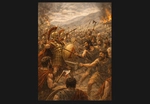
Concerning the dating of the Second Messenian War (or the Revolt of the Messenian Helots), the sources proffer divergent accounts; however, a synthesis of the aforementioned events, coupled with the consideration that the poet Tyrtaeus, a combatant in the said war, flourished circa the mid-seventh century, lends credence to the proposition that the war, or indeed the revolt, ought to be situated around the year 650. Strabo (8.4.10) doth assert that the Messenians were aided by Argos, Elis, Pisa, and (contingent upon the acceptance of an emendation to Strabo’s text) Arcadia. The verses of Tyrtaeus furnish a stark depiction of the dire straits to which the Spartans were reduced during this conflict, threatening their very existence and inflicting upon them grievous defeats:
Tyrtaeus fr. 11:
For ye know the ruinous deeds of sorrow-inducing Ares, and ye have learned full well the wrath of brutal war; ye, young men, have oft tasted flight and pursuit, and have had your fill of both.
The task of ascertaining the precise duration and factual minutiae of this war is rendered arduous by the circumstance that Pausanias’ principal sources were penned in the aftermath of the Spartan defeat at the Battle of Leuctra in 371 by the Thebans, and the subsequent liberation of the Messenian Helots in 370–369. These sources, Myron of Priene and Rhianos of Bene in Crete, writing in the third century B.C., evinced a greater preoccupation with the fabrication of a mythical past replete with glorious Messenian resistance, centred upon such heroic personages as Aristomenes, thereby rendering much of their testimony of questionable value. Nevertheless, it remains evident that the Spartans did ultimately vanquish the Messenians and their allies, and that the entirety of Messenia was gradually pacified and brought under Spartan dominion, possibly as late as 600.
This would serve to elucidate the remark attributed to Epaminondas, the Theban liberator of the Messenian Helots in 370–369, to the effect that he had (re-)founded Messenia after a lapse of 230 years (Plutarch, Moralia 194B).
By the year 600, Sparta had ascended to the position of the most formidable state within the Peloponnese, holding dominion over two-fifths of its territory, and stood poised to acquire augmented power and influence in the sixth century (599–500). Fundamental to this ascendance were the reforms instituted at some juncture in the seventh century. These reforms were of a political nature, effecting alterations to the constitution and accentuating the importance of the hoplites therein; and also of an economic and social character, allotting parcels of Messenian land to its citizens and establishing a warrior elite composed of its citizenry. Tradition ascribes these reforms to a singular reformer, Lycurgus. However, scant historical veracity is discernible concerning the legendary Lycurgus, and his biography as presented by Plutarch forms a constituent element of the aforementioned Spartan myth. Moreover, it must be recognised that these reforms were not necessarily enacted through a single governmental decree, nor were they invariably fixed and immutable, but rather evolved and adapted over a period of time, albeit all modifications were ultimately attributed to Lycurgus. Notwithstanding, for the sake of expediency, the major reforms of the seventh century (699–600), which served to distinguish the Spartans amongst the Greeks and enabled them to attain super-power status, shall be designated as the ‘Lycurgan’ reforms.