The social and economic reforms
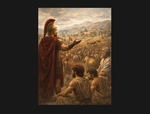
The conclusion of the Second Messenian War mayhap served as the very wellspring whence the reformation of the Spartan polity did flow. The Spartans, having endured a conflict both arduous and exhausting, had secured or re-secured dominion over the entirety of Messenia and its populace. The crux now confronting the Spartans lay in upholding their martial ascendancy over the Messenian Helots, whose numbers did far exceed those of their conquerors. The 'Lycurgan' remedy, beyond the political restructuring enshrined in the Great Rhetra, was to be both economic and social: to wit, the obviating of the need for individual Spartiates to sustain themselves financially through their own agricultural toil, and the recasting of the social order so as to engender a standing army of the first rank.
Howbeit, a considerable scholarly debate doth now rage concerning the precise character of these transformations, particularly with regard to land tenure and inheritance. The received wisdom held that the Spartan authorities portioned Messenia into plots of roughly equal measure ('cleroi'), bestowing one such plot (a 'cleros') upon each citizen. Moreover, to each plot was assigned a requisite complement of state-owned Helots, whose duty it was to till the land and render unto him a portion of its agricultural yield; thus, they may be regarded as 'state serfs', bound to the land and duty-bound to proffer rent. This agricultural tribute from the cleros stood in direct relation to Spartan citizenship: any failure on the part of a Spartan to contribute the stipulated quota of victuals to his dining club or syssition (vide infra), membership whereof was the sine qua non of full citizenship, would entail a forfeiture of citizen rights, thus rendering him an 'Inferior' (Hypomeion). Though discrepancies of opinion may obtain amongst scholars of the traditional persuasion, the fundamental tenets underpinning their view are these: first, the 'Lycurgan' land reform involved a redistribution of land into equal plots; second, a Spartan possessed no right to alienate, that is, to convey his plot to another during his lifetime, whether as a gift or by sale; third, upon his demise, his plot was to remain undivided, he enjoying no right to bequeath it by testament, albeit it most likely passed to his eldest son. To summarise this view, these plots of land were equal in size, inalienable, state-controlled, and inherited by men.
There exist two principal sources upon which this view doth rest: Plutarch, Lycurgus (8; 16) and Plutarch, Life of King Agis IV (5):
Plutarch, Lycurgus 8.1–2:
A second political act of Lycurgus, of no small boldness, was his redistribution of land. … he did persuade them [i.e. the citizens], having pooled together all of the land, to redistribute it anew, and all to live with one another in equality, and to be equal in property for their living.
Plutarch doth further state that Lycurgus allocated 9,000 lots to the Spartans, though, as Plutarch doth mention, some disagreement was to be found among the sources concerning the original number (Lyc. 3). Later, upon the inspection of a newborn child by the elders, he doth say:
Plutarch, Lycurgus 16.1:
If it was well-built and sturdy, they ordered the father to raise him, assigning one of the 9000 plots of land to him [i.e. the child].
Furthermore, the traditional school doth believe that this system of land tenure and inheritance endured until the commencement of the fourth century, when a Spartan Ephor, Epitadeus, did alter the rules of inheritance:
Plutarch, Agis 5.2–3:
Nevertheless [i.e. despite Sparta’s slide into corruption after 404 BC] the number of households that Lycurgus instituted was still preserved, and every father still bequeathed his plot of land (cleros) to his son. But this changed when a man named Epitadeus became ephor … he proposed a law allowing a man to alienate his property and plot of land to anyone he liked, either by gift while living or in his will.
This seminal alteration, it is contended, precipitated the crisis of Sparta in the early fourth century: the accumulation of wealth and land within a select few hands and the consequent dearth of soldier citizens culminated in the shattering defeat of Sparta at Leuctra in 371, as delineated by Aristotle (Politics 1270a-b – vide supra). Even those scholars who cast doubt upon the existence of Epitadeus and his law yet concede that the Spartan social crisis pertaineth to the post-404 imperial years following the defeat of Athens, occasioned chiefly by the pursuit of wealth and the corruption arising from the influx of vast quantities of gold and silver.
The modern school of thought (e.g. Hodkinson) doth disagree radically with the aforementioned view. Firstly, the unreliability of Plutarch and his later sources is emphasized, particularly as they were penned after the third-century revolution and propaganda of Agis and Cleomenes (vide supra in 'The sources'). Secondly, the two systems of land tenure, as depicted in the Plutarch quotations above, are both contradictory and impracticable. The system, as described in Lycurgus 16.1, doth posit state ownership of land, whereby the plot of land (cleros) is assigned by the Spartan authorities; the other (as in Agis 5.2–3) suggesteth a form of private ownership, where the son inheriteth from his father. Moreover, it is highly improbable that Sparta possessed the complex bureaucracy requisite for the administration of such a state-organized scheme encompassing thousands of plots (Lycurgus 16). Furthermore, the system described in Agis 5.2–3 maketh no provision for the granting of a cleros to the younger sons of Spartiates. Thirdly, the earlier, more reliable sources make no mention of an equal redistribution of cleroi by Lycurgus: Herodotus doth not include it in his description of the Lycurgan reforms (1.65–66); nor doth Xenophon in his Constitution of the Lacedaimonians; and Aristotle not only omits it but actually stateth that Phaleas of Chalcedon was the first to propound the notion of equal landholdings (Politics 1266a 39–40). Finally, and most importantly, the traditional school cannot adequately explicate why, under this system of equal, inalienable, state-controlled cleroi, a grievous decline in the number of Spartan citizens did occur from the mid-fifth century at the latest, especially as this decline was linked in some manner with the increasing accumulation of land by a small number of Spartiates and the increasing disparity of wealth betwixt rich and poor, resulting in the reduction of many citizens to non-Spartiate status, i.e. 'Inferiors' (Hypomeiones).
The modern school doth opine that land ownership and inheritance in archaic and classical Sparta was akin to that of other Greek states, that is, the land was privately owned, and the customary rules of inheritance whereby a father bequeathed his land to his children were in effect. It is also asserted that land was inherited not only by the sons but also by the daughters, who may have received as much as a half portion of her brother or each of her brothers. However, their portion would most likely be conferred not upon the death of the father but as a dowry when the daughter did marry. It is this divergent system of private ownership and inheritance that doth more convincingly elucidate the continual decline of Spartan citizens from the fifth century onwards. The key source for this view is Book 2 of Aristotle’s Politics. Touching the weakness of Lycurgus’ legislation concerning the inequality of property ownership, Aristotle doth say:
Aristotle, Politics 1270a:
For he [i.e. the lawgiver] quite rightly made it dishonourable to buy or sell land in someone’s possession but allowed those who wished to give and bequeath it … moreover nearly two-fifths of all land is possessed by women.
Later on in the same passage, Aristotle doth criticize the laws that were introduced to encourage an increase in the Spartan population:
Aristotle, Politics 1270b:
For the lawgiver, intending that the Spartiates should be as numerous as possible, encourages the citizens to beget many children … But it is obvious that, if many are born and the land distributed accordingly, many must inevitably become poor.
On the basis of Aristotle’s evidence, it was permissible, as a typical private landowner, to transfer land as a gift during one’s lifetime or to bequeath it to whomever one did fancy. Even the sale and purchase of land is a matter of dishonour but not of illegality. Furthermore, those families of the Spartiates who heeded the lawgiver’s encouragement for larger families inevitably fell into penury, as their land was divided up at their death amongst their sons and daughters into ever smaller parcels of land. Howbeit, the wealthy Spartiates, whose number is well attested throughout the classical period (Herodotus 6.61.3; Thucydides 1.6.4; Xenophon, Lac. Pol. 5.3), like the rich in other polities, did carefully plan their marriages, procreation, and bequests, employing these laws to consolidate their wealth and, where possible, to augment their landholdings. Thus, wealthy families ensured that their children did marry into wealth. Families were kept small to prevent the diminution of the estate owing to too many heirs – hence the practice of one wife being shared betwixt two men to keep the number of inheriting children small in both families. Furthermore, if the evidence of Philo, a first-century AD Jewish scholar, who stateth that in Sparta uterine siblings (i.e. children from the same mother but different fathers) could marry (On Special Laws 3.4.22), is accepted, a marriage betwixt the half-brother and the half-sister of the shared mother mentioned above would result in the inheritance and concentration of even more land. A childless Spartiate could adopt a kinsman as his heir, thus keeping the land within the kinship group – also further evidence of the right of a Spartiate to dispose of his land as he did wish.
One final quotation concerning land tenure must be mentioned, which hath caused great difficulty amongst all scholars and doth resist a consensus of opinion. It cometh from Heracleides Lembos (fr. 373.12 Dilts), a second-century statesman and scholar, and is considered to be derived from Aristotle’s lost Constitution of the Lacedaimonians:
Constitution of the Lacedaimonians:
To sell land is considered shameful by the Lacedaimonians, but from the ancient portion (archaias moiras) it is not allowed.
Some scholars view this source as evidence of two categories of land: private land that can be sold (albeit socially unacceptable) and state-controlled land – 'the ancient portion' – which it was expressly forbidden to sell. Some scholars equate this 'archaia moira' with the cleroi of Lycurgus; others, that this refereth to landholdings in Messenia which were given to poorer Spartans after the Second Messenian War so that they might meet the obligations of citizenship; still others believe that it refereth to land that hath been in the possession of a Spartiate’s family for many decades, to differentiate it from any newly acquired land. The latest view, i.e. Hodkinson’s, is that this 'ancient portion' hath naught to do with land but referreth to the Helots’ rent, his agricultural payment in kind.
As regards the 'Lycurgan' economic and social reforms in archaic Sparta, with all the attendant problems of the sources and the constant reinvention of the Spartan myth, it is difficult to furnish a definitive answer, as Plutarch doth in the Life of Lycurgus. It seemeth most improbable, however, that there was a 'Big Bang' moment when a new 'Lycurgan' system suddenly did appear ready-formed, like an Athene springing forth from Zeus’ head. The fact that there was no revolution and no tyranny in Sparta doth strongly suggest that a consensus was reached amongst the Spartiates as a whole and that a collective decision was taken to adapt their economic and social (and political) institutions to meet the new demands of the seventh and sixth centuries. Firstly, it must have been agreed at some time that every Spartan would be a hoplite citizen (usually one-third of the population in other polities), whose legal duties would include daily attendance at one of the dining clubs (syssitia), where all the Homoioi (Similars/Peers) did dine. Secondly, there must have been a distribution of some land, most likely in Messenia, together with allocated Helots to the poorer citizens so that they had the wherewithal to provide their compulsory quota of victuals to their syssition (dining club), upon which their citizenship did depend, and the opportunity to carry out their full-time civic and military duties. Finally, a social system, a common way of living (including education), was agreed upon, stretching from birth to death, and in which all citizens must participate. It was this third element that was subject to change, modification, and refinement over the decades of the late seventh and the sixth centuries.
Part of the social reform involved the agoge, or the state military education system, which is described in detail by Xenophon (Con. of the Lac. 1–4) and Plutarch (Life of Lycurgus 14–25). Again, it is not possible to furnish a definitive answer as to when all the different and distinctive elements of the agoge were introduced (even the term agoge may be of third-century origin), albeit it too must have undergone changes over the decades, even centuries. Its objective was to cultivate the ideal qualities of a first-class soldier-citizen: patriotism, obedience, loyalty, comradeship, community spirit, and uniformity. From the age of six, every male child, save the royal heirs-apparent, was removed from his family, and joined groups of other boys in a communal life where, over the next fourteen years, they acquired, through harsh, even brutal, training, the physical strength, the discipline, and the fighting skills that did render the Spartans the most feared of all soldiers. Once they had served their apprenticeship in the agoge, they became 'eirenes' at the age of 20 and were then eligible to join a syssition (dining club). Each syssition would consist of roughly fifteen members (Plutarch, Life of Lycurgus 12) of different ages, who were expected to attend every night for the rest of their lives and share a common meal. The young Spartan man ('eiren'), once admitted, would reside in the syssition for the whole of his twenties, even if married, where his older companions would complete his education by assisting him to integrate into the adult Spartan life of training, fighting, and dining. At a certain age, perchance 30, he became a full citizen and was entitled to attend the Ecclesia (Assembly) and to reside with his wife. Thus, the syssition, and not the family, thus communal, rather than private life, became the main focal point of a Spartan’s existence. The result was the first full-time, professional army in Greece, which not only kept the Helots subdued but enabled the Spartans to spread their power throughout the Peloponnese in the sixth century.