Greek Colonization (c. 750–550 BCE): Expansion, Trade, Land Pressure, and the Rise of the Polis
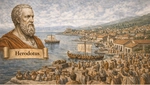
The grand epoch of Greek colonisation is intimately linked with the span extending from the latter moiety of the eighth century unto the former moiety of the sixth. Greek colonies were dispatched westward to Sicily and southern Italy, nay, even as far as the southern coast of France and the eastern seaboard of Spain; eastward to the Thracian coast, the Hellespont, and round about the littoral of the Black Sea; and southward to Cyrenaica in modern Libya, upon the northern coast of Africa. A prior epoch of Greek colonisation did obtain during the Dark Ages (1200–900 BC) subsequent to the fall of the Mycenaean civilisation in the twelfth century: that which is denominated the Ionian and Dorian migrations. According to tradition, the Dorians, under the leadership of the sons of Heracles, who had been exiled from Mycenae, did return to Hellas to reclaim their inheritance by force, which resulted in the Ionians seeking refuge from them by crossing the Aegean Sea and settling in Asia Minor; howbeit, it was not on the same scale nor as well-organised as this later expansion. The close of the Dark Ages did usher in an era that witnessed the rediscovery of long-range travel by sea, widespread commerce around the Mediterranean, the re-introduction of writing, and the rise of the Greek ‘polis’, or city-state. The eighth century (799–700) was a period of remarkable economic growth, with agricultural development occasioning a general augmentation in the level of prosperity, especially for the aristocracy, whose political control over their own polis was predicated upon their tenure of the finest and the largest tracts of land, as well as their capacity to defend the state from external menaces. Land, especially in a pre-coinage era, was the most valuable of all possessions, inasmuch as it was the sole guarantee of permanent wealth. Nevertheless, the eighth century did also witness the rise of grave social problems in Hellas, which were linked directly or indirectly with the land.
Scholarly opinion in times past hath been deeply divided over the causes of colonisation: whether it was land-hunger, arising from over-population, or commerce that was the primary cause. These stark alternatives have proven unsatisfactory when all the evidence is considered, especially with the growth of archaeological excavations in colonial sites. In addition, there exists a necessity to clarify what is signified by ‘commerce’ before it can be proffered as a motive for colonisation: whether it be a search for foreign markets for the state’s own exports, or a quest for vital resources which the state lacks and can import. It is also vital at the outset to make a clear distinction between a colony (‘apoikia’) and a trading station (‘emporion’), both of which are present from the eighth century. The colony was an independent city from the start, founded at a particular date and by a public act, which possessed its own government, laws, and foreign policy, and whose inhabitants were citizens of the colony and not of the mother-state. The emporion was, by contrast, a strictly commercial trading post, which was formed spontaneously by traders from divers Greek city-states, nay, even by non-Greeks. However, even this clear distinction could at times be obscured: Herodotus doth refer to the Milesian colonies on the north shore of the Black Sea as emporia.