Trade Networks and Strategic Foundations in Greek Colonization: Emporia, Metals, and Mediterranean Connectivity
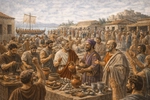
Nevertheless, trade did indeed play a most significant role in the foundation of colonies. It was the pursuit of vital commodities (such as metals) and luxury goods, both greatly desired by the ruling aristocracies, that opened up the Mediterranean after the Dark Ages. This led to traders establishing trading posts in the east and the west, especially on the frontiers of a great power, thereby affording them access to foreign markets. The most important trading post (emporion) in the east was at Al Mina at the mouth of the river Orontes in northern Syria. It was founded just prior to 800 by Phoenicians, Cypriots and, as hath been established from pottery on the site, Euboeans. Iron from south-east Asia Minor and luxury goods from Mesopotamia, Phoenicia and Egypt flowed into Al Mina, where they were crafted into attractive ornaments, and were transported for trade with Greece and the west. In a fashion most similar, Chalcis and Eretria together founded a trading post (albeit it may have been intended as a colony) circa 775 at Pithecusae on the bay of Naples (modern-day Ischia). This was at the southern edge of the area dominated by the Etruscans who were, in their own right, rich in metal, but also controlled the trade in tin and amber that came from Britain and the north. Thus, there existed a trade route stretching from the near east to the Etruscans in the west via Al Mina and Pithecusae: many Egyptian scarabs and seals from north Syria have been unearthed at Pithecusae.
It is clear that these traders were the essential precursors of the colonising movement, since it was their intelligence respecting the location of fertile agricultural sites, gained from their overseas trading, that furnished the colonisers with the confidence to seek a new life in a foreign land. However, there are certain colonies where the evidence doth point to trade rather than land as the principal cause of their colonisation. Some of the inhabitants of Pithecusae moved later to the mainland opposite and founded Cumae, which was reputed to be the oldest Greek colony in the west. The existence of sufficient cultivable land to support the population, which was not the case at Pithecusae, was clearly an important reason for Cumae’s foundation. Nevertheless, its close proximity to the Etruscans and the deliberate decision to ignore fertile land that was still abundantly available for colonisation in Sicily and southern Italy doth strongly suggest that the on-going trade in metals with the Etruscans was a decisive factor in its siting. Zancle (later Messana and then Messina) was founded circa 730 by the Chalcidians from Euboea; but, because of the shortage of cultivable land, its foundation can only be explained by the need to control the straits of Messina and the trade route to Pithecusae. This lack of agricultural land led Zancle to send settlers a little later to found Mylae, 20 miles to the west. Having taken possession of one side of the straits of Messina, it made sense to tighten their control by founding, with the help of Messenians and Chalcidians from home, Rhegium on the other side on the Italian mainland. In the same way, the expulsion of the Eretrians from Corcyra in 734 by the Corinthians, who were on their way to found Syracuse, doth clearly show that the Corinthians were very aware of the strategic importance of Corcyra on the trade route to the west.
By the mid-seventh century, the importance of commerce was becoming even more obvious to the Greeks, and the later colonisation of the north shore of the Black Sea by Miletus, such as the colony at Olbia, circa 645, suggests that trading motives may have been behind their foundation. At this time, the cities of the Greeks in Asia Minor were being threatened by the growth of the Lydian empire. Therefore, access to the abundant corn supplies of the Black Sea would have done much to ease their dependence on homegrown corn, and the opportunity to import corn may have been the incentive for Miletus to send out its colonies to this area. Herodotus was very aware that these northern Black Sea colonies acted as trading centres and consequently referred to them several times as emporia (trading posts). The second wave of Corinthian colonies, founded by Cypselus and his successors in north-west Greece at Leucas, Anactorium, Ambracia, Apollonia and Epidamnus (with Corcyra), doth reflect the increasing importance of commercial motives for colonisation. These colonies were key staging posts on the trade route to Italy; they also afforded access to the raw materials from the north-west, such as timber and flowers for Corinthian perfumes; and finally, they supplied the base for Corinthian trade to increase its outlets in the interior, as can be seen from the early Greek bronzes found at Trebenishte. Finally, the Phocaeans, on the western coast of Asia Minor, furnish the best example of colonisation motivated by trade. They founded Massalia (modern-day Marseilles) circa 600, which was poor in agricultural land but controlled the trade routes up the river Rhone, leading to commercial links with Paris, Switzerland, Germany and even Sweden. They also founded Emporion – a most revealing name – in northeast Spain at the same time as Massalia, and traded as far as Tartessus beyond the straits of Gibraltar, gaining access to tin and silver in northern Spain.
To summarise, it is probably right to see the desire for cultivable land as the primary cause of colonisation, since the majority of Greeks depended for their livelihood on agriculture, and the serious social and economic problems of over-population and land-hunger did coincide with the colonising movement in the second half of the eighth century. Trade was certainly the primary consideration in the foundation of a few colonies and an increasingly important factor in numerous others, but it is difficult to argue that it was the main cause, as this view requires unequivocal evidence that the economy of the colonies was based on trade from the beginning. Such evidence, by its very nature, is rarely available to the archaeologist.