Hoplite Warfare and the Military Origins of Greek Tyranny: The Case of Pheidon of Argos
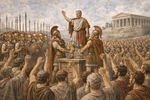
The preponderance of opinion amongst modern historians doth incline towards the view that the salient innovation in military tactics – to wit, hoplite warfare – did originate in the first quarter of the seventh century. Prior to this epoch, the principal defence of the state did rest upon the aristocracy, who furnished the individual expert warriors, these latter most likely riding on horseback unto the field of battle, yet engaging in combat on foot with opposing warriors of similar station: a manner of fighting that Homer doth so vividly depict in his Iliad. However, the novel style of combat did necessitate a greater complement of men (oftentimes as much as a third part of the citizen population), heavily armed with weapons and body armour of a uniform nature, and fighting in a densely packed formation, or phalanx, typically arrayed in eight rows deep. Contrasting with the prior mode of combat, wherein individual courage and expertise were of vital import for military success, the cardinal hoplite virtues were steadfast courage and discipline in maintaining the battle-line, inasmuch as any uncoordinated movement, be it forwards or backwards, on the part of individuals would cleave the tight formation and fatally weaken the whole. This very point was underscored by Tyrtaeus:
Tyrtaeus fr. 11. 11–14:
Those who display the courage to go into close combat in the front line, standing side by side with each other, die in fewer numbers and save those behind. But when men tremble, the courage of all is destroyed.
It was the genesis of this new fighting force, involving, as it did, a greater number of citizens participating in the defence of the city, that hath prompted many a scholar to posit a military cause for tyranny.
The essence of the disagreement 'twixt modern historians – anent the role of the hoplites in the rise of tyranny – doth centre upon the dating of their introduction into Grecian warfare, and its attendant effect upon tactics. One school of thought (e.g. Snodgrass) doth hold the view that the hoplite ‘panoply’ – comprising helmet, corselet, greaves, sword, spear, and shield – was introduced in piecemeal fashion over a protracted interval, from circa 750 to circa 650; and that there existed a transitional stage of tactics 'twixt the former aristocratic individualistic duels and the later middle-class hoplite phalanxes. The individual warriors, initially aristocrats, but subsequently substantial landowners, adopted individual items of the distinctive hoplite panoply as they became available in 750–650, and fought in a formation reasonably close until circa 650, at which juncture fighting in the densely packed hoplite phalanx became standard tactics. Consequently, hoplite warfare and the growing class-consciousness of the middle classes, which arose subsequent to the introduction of hoplite warfare, came too late to be a factor in the early tyrannies of Pheidon of Argos, Cypselus of Corinth, and Orthagoras of Sicyon. Indeed, it was the tyrant in power who brought about the hoplite phalanx, and not vice versa.
The other school of thought (e.g. Cartledge, Salmon) doth believe that there was an abrupt alteration to hoplite tactics 'twixt 700 and 675, inasmuch as, albeit there was ongoing experimentation in the use of weapons throughout 750 to 650, the invention of the two most distinctive pieces of hoplite armour, viz., the shield and the Corinthian helmet (which make their maiden appearance on vases circa 700), could only be efficacious within a densely packed hoplite phalanx. The hoplite shield differed from its predecessors, possessing as it did a double grip, one at the centre for the forearm, and the other at the rim for the hand; earlier shields having but a hand grip at the centre. As a result, the hoplite shield was of a far greater weight and less manoeuvrable, far better designed for close-to-body holding, for frontal defence, and for pushing. When held in place, this shield did only necessitate half of its structure to protect the front of the hoplite, albeit it afforded no protection to his spear arm and right flank; its other half, to the left of the hoplite, was wasted space, qua the holder’s own defence needs. Nevertheless, within a hoplite phalanx, this unnecessary space was of vital import and was primarily designed for the protection of the right flank of the next hoplite to the holder’s left, and so on down the line. Furthermore, should neither phalanx break in the initial clash of front lines, the heavy shield came into its own as an offensive weapon, as recorded in the hoplite battle of Delium in 424:
Thucydides 4.96. 4–6:
But the right wing, where the Thebans were, was getting the better of the Athenians, pushing them back step by step and keeping up the pressure … and, because of such a manoeuvre [i.e. the use of cavalry] and the Thebans pushing them on and breaking their line, the flight of the whole Athenian army took place.
In similar wise, the Corinthian helmet, fashioned from a single sheet of bronze which did cover the entirety of the head, save for a T-shaped opening for the eyes and mouth, would only have been efficacious in frontal hand-to-hand fighting, where the severely restricted vision and hearing were of far less moment than protection for the whole head and neck. Consequently, the hoplite phalanx made its maiden appearance soon after 700, was widely employed in the second quarter of the seventh century (675–650), and thus was available to play a part in the political upheavals of the seventh century.
However, Morris hath challenged the views of these two schools of thought by rejecting the whole concept of a ‘hoplite reform’ in military tactics. He doth believe that the Greeks had always fought in massed ranks, and that the weapon changes from 750 to 650 do but mark an improvement in the quality of weaponry, and not an alteration in military tactics. It is argued that a fundamental misunderstanding of Homer and the conventions of eighth- and early seventh-century vase-painters hath led to the belief that so-called ‘pre-hoplite’ warfare did only consist of individual duels 'twixt aristocrats, with no fighting role for the remainder of the populace, apart from the throwing of stones and the shouting of encouragement. A careful study of Homer doth evince that his battles were extensive in time and location, and that massed rank tactics were always employed; but that his ‘freezing’ of the action on different (yet concurrent) individual duels, purely for literary and artistic purposes, hath misled scholarly opinion on the nature of Homeric warfare. Furthermore, until the creation of the Chigi vase in circa 660–650, which was the first to show clearly warriors in a closely packed formation, it had been the convention to portray each massed and opposing rank by the painting of the two nearest warriors, engaged, apparently, in individual combat. Therefore, the theory of a military cause of tyranny, which hath been based upon the so-called ‘hoplite reform’ and its use by the tyrants for political purposes, ought to be eliminated.
However, those scholars who do avow a military cause of tyranny do utilise Aristotle as further support for their view. He doth state that there was a direct political link 'twixt the class that was most efficacious in defending the state, and the state’s type of constitution:
Aristotle, Politics 1279a–b:
Although it is possible for one man or a few men to be superior in virtue, it is difficult for the many to be made perfect in every virtue, but they can be in the virtue of military courage, for this is found among large numbers. Therefore the class that does the fighting for the state wields supreme power in this constitution, and those who bear arms have a share in its government.
He doth re-affirm this belief later, when he doth stress that, after kingship had come to an end, government passed into the hands of the aristocracy, who possessed the necessary wealth to furnish the cavalry that was the backbone of the state’s defence, but:
Aristotle, Politics 1297b
when the population of states had increased and those who possessed hoplite weapons had grown stronger, more persons came to have a share in government.
Aristotle doth not include tyranny as one of the stages in the political development of the polis, yet it made its appearance soon after the invention of hoplite warfare (if this is accepted), and was in some cities the transitional stage of government 'twixt aristocratic and hoplite-dominated constitutions. The belief that the hoplites probably played the leading role in helping a tyrant to seize power by furnishing the armed might that was superior to that of the aristocratic warriors is strongly implied in another quotation of Aristotle:
Aristotle, Politics 1305a:
In the old days, whenever the same man became leader of the people and general, they turned the constitution into a tyranny. For nearly all of the old tyrants came to power from being leaders of the people; and the reason why that happened then, but not now, is that those earlier leaders of the people were drawn from those who held the generalship.
The special rapport that can exist 'twixt a general and his troops against a common enemy, seen so vividly in the last century of the Roman Republic, was seemingly utilised by the ambitious tyrant in his quest for power. The best example of this military cause of tyranny doth lie with the career of King Pheidon of Argos, albeit the evidence is oftentimes inadequate and circumstantial.
The mention of the Olympic Games is crucial in the attempt to pin down a date for Pheidon’s activities. The late sources (Strabo, Eusebius and Pausanias) state that the Dorian Eleans presided over the games from their alleged inception in 776, but that in the seventh century (the sources do not agree on the date) the pre-Dorian Pisatans, who had been subjugated in the Dark Ages by the Eleans and were consequently an under-privileged group, seized control of the Olympic Games. The Olympic victor lists, which were published by Hippias around 400 and are considered to be reliable, record a time of Pisatan control beginning around 668, and Pausanias (6.22.2) dates the trouble at the Games to the 8th Olympiad (748), but this has been plausibly emended to the 28th Olympiad in 668. If the Pisatans gained control of Olympia in 668, it can be argued that they would have needed the help of an external military power to achieve this coup, and Herodotus’ mention of Pheidon’s intervention at Olympia makes him the most likely candidate. However, it is worth noting that Ephorus places Pheidon 50 years earlier, but this may be a guess, and Herodotus more than 50 years later.
If 668 is accepted as the date of Pheidon’s military intervention at Olympia, then he can be linked, although not named as the commander, with the major victory of the Argive army over the Spartans at the battle of Hysiae in 669 (Pausanias 2.24.7). Hysiae is on the plain of Thyrea on the border between the territories of Argos and Sparta, and the likely cause of the conflict was the expansion of these two powers, disputing control of the plain. These are the years before Sparta’s army came to be the best in Greece, but it was still a formidable force, which emphasizes the superior excellence of the Argive army in the first half of the seventh century. This sudden re-emergence of Argive status and military prowess in Peloponnesian politics is explained by Ephorus (FGrH IIA 70F115) who stated that Pheidon regained the Lot of Temenus. Legend had it that the descendants of Heracles returned to the Peloponnese in three companies during the Dark Ages and divided up their conquests by lot: one brother received Messenia, the second Lacedaimon and Temenus the Argolid. However, after Temenus’ death, according to Ephorus, the Argive kingdom became weak and divided until it was reunited by Pheidon. If the legendary overlay is removed, it seems that Pheidon restored strong central government to Argos and masterminded the expansion of Argive power throughout the Argolid which led to the battle of Hysiai with Sparta.
If the above evidence (for all its limitations) is accepted, then the likely cause of Argos’ brief revival of military dominance and of Pheidon’s unusual constitutional position of a king turned tyrant (Aristotle, Politics 1310b – see above,) is the introduction of hoplite warfare. Argos either was the first state to use these new tactics or used them far more effectively than their opponents. The shield – the most distinctive piece of hoplite equipment – was called generically ‘Argive’ (Pausanias 8.50.1), either because it was invented in Argos or because the Argives were remembered for their outstanding skill with it. Yet more revealing is the Delphic oracle about Chalcis and Argos:
Palatine Anthology 14.73:
The best of all land is the Pelasgian plain, best are the Thracian horses, Spartan women and the men who drink the water of fair Arethusa [i.e. the men of Chalcis in Euboea].
But better still than these are those that live between Tiryns and Arcadia of the many sheep, the linen-corsleted Argives, the goads of war.
This oracle must be dated to the first half of the seventh century, since Sparta’s pre-eminence in hoplite warfare was recognized from the late seventh century onwards. There is an illogical progression in the oracle in that it mentions the best at the beginning and then supersedes this by naming someone better. Presumably the second part is a later addition to the original oracle which was occasioned by the Argives’ later military superiority to the Chalcidians. Thucydides (1.15) states that the first war of any importance that split a number of Greek states into two camps was the Lelantine War between Chalcis and Eretria in Euboea, probably fought in the last 30 years of the eighth century. The victory of Chalcis earned for its soldiers the reputation contained in the first part of the oracle. Therefore it would seem that the Chalcidians were the best in pre-hoplite fighting, but that their reputation was overtaken by the Argive hoplites, who enjoyed such military success in the Peloponnese.
It is at this point that Aristotle’s description of King Pheidon’s seizure of power as tyrant can be explained. Pausanias 2.19.2 stated that the authority of the Argive kings had been drastically reduced as early as Medon, Temenus’ grandson. The fact that political power was in the hands of the aristocracy in the early seventh century is to be expected, since it was the common situation throughout the Greek world at that time. If Pheidon was the inventor and leader of the hoplites, then it is possible that he saw his opportunity, in tyrant fashion, to make use of this new military force to overthrow the aristocratic government, and to advance his own career and the interests of his hoplite supporters. His political success with the help of the hoplites would have set a precedent for others to follow.