Ancient Roman History: Tutorials & Publications
History of Rome Library: from the establishment of Rome as a city-state to the decline of the Roman Empire

The Seven Kings of Rome: Political, Social, and Economic Evolution (753–509 BCE)

An in-depth educational overview of Rome under its legendary seven kings, from Romulus to Tarquinius Superbus. The article traces the evolution of political institutions, urban development, social structures, military organization, and economic practices, highlighting how early Rome grew from a small settlement into a proto-state. It examines monarchic authority, the Senate and assemblies, the census, urban infrastructure (bridges, ports, Cloaca Maxima, walls, temples), population integration, and trade. Economic activity is explored, from subsistence agriculture and tribute collection to river trade and state-controlled resources, noting that formal auctions and structured market institutions did not yet exist in Rome, unlike contemporary Greek poleis. The narrative shows trends towards complex social interactions, proto-commercial activity, and preparation for the Republic.
The Early Roman Republic (509–448 BC): Governance, Law, Economy, and Society
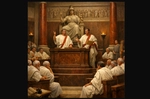
A comprehensive overview of the formative period of the Roman Republic, from the expulsion of Tarquinius Superbus to the stabilization of economic and legal institutions around 448 BC. The article examines political transitions, year-by-year consuls, key Republican institutions (consuls, Senate, tribunes, assemblies, censors, magistrates), the Decemvirate and codification of the Twelve Tables, the early monetary system, and the central role of auctions in economic life. Social structures, military organization, plebeian rights, and interactions between political authority and legal reforms are analyzed, highlighting the foundations of Roman civic, legal, and economic stability.
The Twelve Tables of Rome: The Roman Decemvirate (Decemviri Legibus Scribundis)
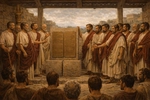
An overview of the Twelve Tables (Lex Duodecim Tabularum) and their significance in the historical development of Roman law.
Monetary System in the Early Roman Res Publica
An overview of the early Roman market, covering auctions, trade rules, and financial practices.
Two Empires, Two Destinies

The division of the Roman Empire into Western and Eastern parts was not a sudden collapse, but a gradual administrative and political transformation driven by scale, instability, and structural pressures. This is a course of lectures covering this period.
The Decline of the Western Roman Empire

By the mid-5th century, the Western Emperor had little actual power, controlling only parts of Italy. In 476, the Germanic chieftain Odoacer deposed the teenage emperor Romulus Augustulus, choosing to rule as King of Italy rather than appointing a puppet emperor, marking the conventional end of the Western Roman Empire.